
We got 2 quotes on a rectangular mint tin. Both are the same size, printed in CMYK and 5,000 pieces. One has individual protective packing and an insert. And the other says “standard packing” and sampling charged separately.
The unit prices are easy to compare. What you get for those prices takes a bit more work.
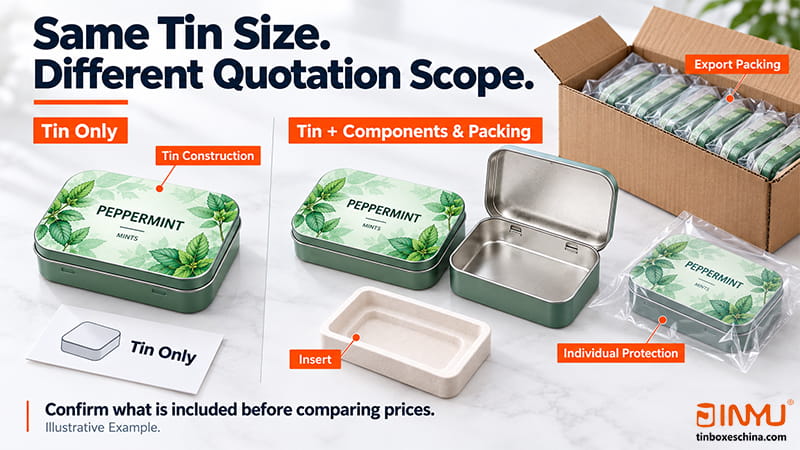
Send the same RFQ to every supplier with dated drawing, artwork and packing revisions. Have them confirm the requirements and note any differences.
'Same size, four-colour printing' leaves a lot to be decided. Two tins may be identical in outside dimensions but different in internal space, lid construction, coatings or packing arrangements.
Use a checklist of specifications before price comparison:
| Item | What the quotation should confirm |
| Dimensions and drawing | Outside dimensions, critical internal dimensions, measurement definitions, drawing revision and key tolerances |
| Lid and construction | Slip, hinged or slide lid; edge and seam construction; required opening and closing performance |
| Material | Tinplate thickness and any other agreed material specifications |
| Printing coverage | Lid, body, base and inside printing; approved artwork revision |
| Colours and background | CMYK or spot colours, white underprint, exposed metallic areas and colour reference |
| Coatings and finishes | Internal coating, gloss or matt finish, special finishes and embossing |
| Inserts and components | Material, dimensions, quantity and whether assembly is included |
| Order quantities | Total quantity, quantity per design and number of artwork versions |
| Individual protection | Bags, sleeves or other protection; assembled, separated or nested tins |
| Export packing | Pieces per carton, carton specification, shipping marks and pallet requirements |
| Use and acceptance | Product application, destination market, reference sample and agreed checks |
If a supplier proposes an alternative thickness or packing, ask for a separate alternative quotation. Retain the original specification for comparison.
5,000 tins with one artwork is a different production brief than 5,000 tins with several designs. Check the number of units for each price quoted including any minimum quantity per version.
Do not put a 10,000 piece price break next to a 5,000 piece offer as if the buying commitment were the same.
Also see what is included in “existing mould”. A suitable body mold does not mean the need for new embossing tools, print preparation or insert development. See Multiple Tin Designs in One Order: What Can Share a MOQ? for multiple versions.
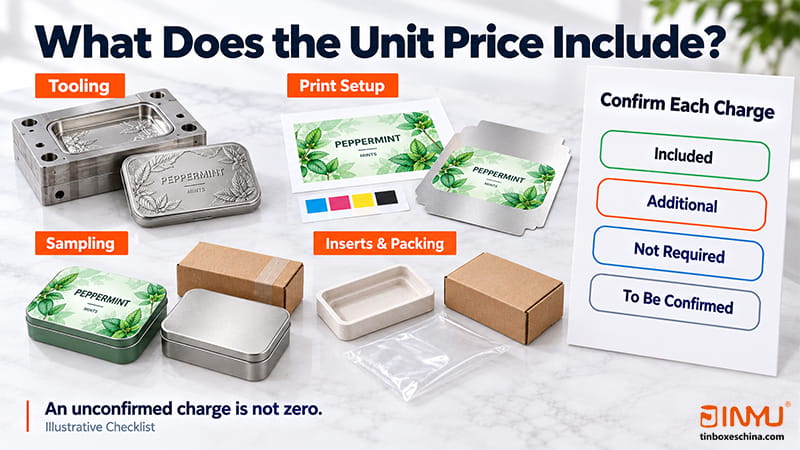
Ask suppliers to indicate whether each applicable charge is Included, Additional, Not Required or To Be Confirmed. A blank cell is not zero.
Tooling check, embossing dies, print preparation, sampling, sample courier charges, insert development, testing & inspection. Verify if quoted extras are per order, per design or per tool.
If a sample fee is applied against production, note the conditions and when the credit applies. deduct only a credit agreed for the order being compared;
Separate first order and repeat order costs. If you already have a tool for a reorder there may be new charges if there are changes to the artwork or components. The custom cookie tin quotation breakdown goes into greater detail on manufacturing cost drivers.
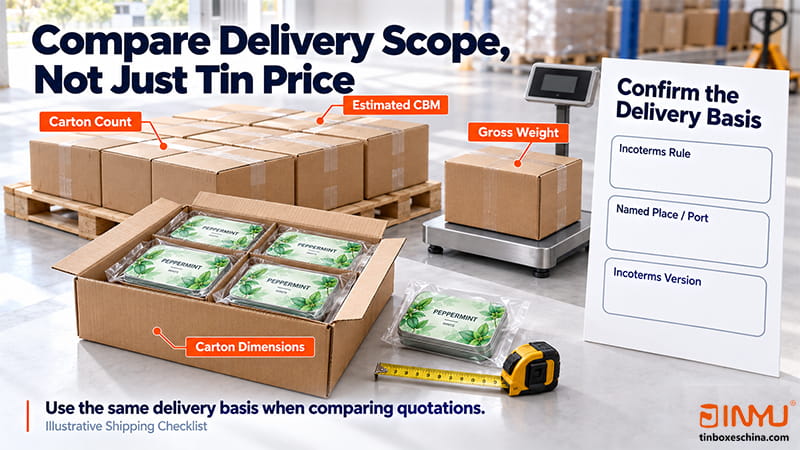
“FOB” without a named port leaves an important detail unresolved. Record the Incoterms rule, named place or port and version e.g. “FOB [named port], Incoterms® 2020”.
The ICC’s Incoterms® 2020 rules define how delivery obligations, costs and risks are shared between buyers and sellers.[1] They do not replace the tin spec or sample approval. International Chamber of Commerce
The simplest way to compare is to ask for both quotations on the same delivered basis. Otherwise, find out the other costs that will take you to the same place. Add costs not included in quoted scope.
The landed-cost guidance of the International Trade Administration considers product price, freight, insurance, tariffs, taxes and other fees to arrive at a full delivered-cost calculation.[2] Request carton quantities, dimensions, gross weight, estimated cubic meters and pallet details. trade.gov
Keep estimates clearly marked until confirmed. Individual protective packaging can change the volume of the shipment. So good tin price may need different freight.
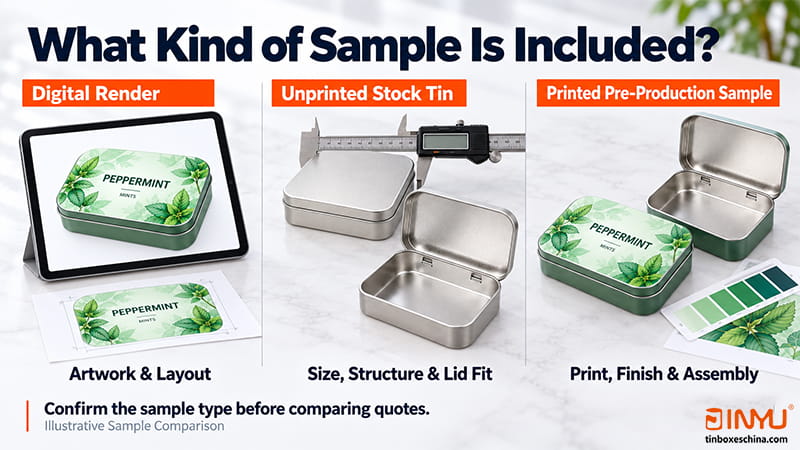
“Sample included” – what does that mean? A digital render, an unprinted stock tin and a printed pre-production sample answer different questions.
Check equivalent samples for lid fit, opening and closing, edge finish, dimensions, printing and finish. Agree how production is checked against the approved sample and specification, who arranges and pays for inspection.
For food tins, request documentation related to the actual materials, coatings, intended contact and destination market. The FDA guidance ties the regulatory status of an ingredient substance to the intended conditions of use of the project in the US.[3] The details are not substituted by a general factory certificate. FDA
The food-contact document checklist can assist in organizing the request.
Example: These figures illustrate the calculation, not actual Jinyu customer orders or current market prices.
The buyer wants 5,000 tins with one design. Quote A does not speak of protecting individuals. Quote B does. The buyer asks both suppliers to confirm the same specification including inserts, protection and acceptance requirements, before comparing the two revised offers.
The comparison of goods and confirmed net additional charges is as follows: Freight and import costs are separate.
| Comparison item | Quote A | Quote B |
| Quantity | 5,000 pcs | 5,000 pcs |
| Unit price | USD 0.64 | USD 0.70 |
| Goods subtotal | USD 3,200 | USD 3,500 |
| Confirmed net additional charges | USD 450 | USD 100 |
| Total for the stated scope | USD 3,650 | USD 3,600 |
| Allocated cost per tin | USD 0.73 | USD 0.72 |
Apply this formula:
Cost for the agreed scope = unit price × quantity + net additional charges not otherwise included.
Quote A saves USD 300 on goods and is six cents per tin cheaper. The total of the compared order is USD 50 higher, USD 350 of the additional charges.
That flips the price ranking, but does not automatically choose Quote B. Samples, delivery costs and commercial terms to be confirmed. If the specifications are still different, ask for clarification, don’t assume the totals are equal.
A full comparison is also needed
Before approval collect specification, quantity breakdown, cost schedule, delivery basis and sample acceptance requirements confirmed. Take down any remaining questions.
Outside dimensions describe only part of the product. Material, construction, printing, inserts, packing, quantities and delivery scope may differ.
Keep both visible. The unit price helps compare goods costs; the total shows what the agreed order requires you to pay.
Request quotations using one agreed delivery basis and named location. If that is unavailable, obtain the missing logistics costs needed to compare delivery to the same destination.
No. Confirm each charge and any credit conditions. Do not assume that an existing mould makes every preparation or sampling service free.
Ask for the requested specification and the alternative as separate offers. Assess the alternative’s price and performance on its own merits.
No. Shared specifications make comparison clearer, but physical samples and agreed production checks are still needed to assess the result.
For a Jinyu quotation, send the drawing, lid type, artwork, quantity per design, finishes, inserts, packing requirements and delivery destination. Include the intended use and target delivery date so the offer can identify included costs, proposed changes and unresolved items.
Get The Latest Information And Special Offers


 IPv6 network supported
 English
 Français
 Deutsch
 Español
 Português