
We’ve seen it all.
A brand spends months perfecting a beautiful logo. The design looks great on screen. The product launch date is fixed. Everyone is excited.
Then the tins arrive.
The hinge feels loose. The lid doesn’t close smoothly. The gold color looks different from the approved artwork. Some cartons are dented. The food-contact documents are not clear enough for the buyer’s market.
It’s frustrating.
And honestly, most of these problems are avoidable.
If you’re sourcing hinged tins for the first time, this guide is for you. If your last batch of candy or mint tins gave you a headache, this guide is definitely for you.
Hinged lid candy tins may look simple. But from a factory point of view, they are not just “small metal boxes.” They involve tinplate material, mold accuracy, hinge fitting, printing control, food safety, packing strength, and export quality inspection.
As a custom candy tin manufacturer, we want to share the common mistakes we see buyers make when sourcing wholesale mint tins with hinged lids and custom candy tins.
Let’s get into the real issues.
A pretty tin is not always the right tin.
That sounds obvious. But this is one of the most common mistakes buyers make.
You may see a sample photo and think, “This size looks perfect.” But does your candy actually fit? Can your filling team pack it efficiently? Will the product move too much inside the tin? Will the consumer find it easy to take the candy out?
Here’s the thing: product fit matters more than appearance at the early stage.
For mint tablets, you need to think about tablet size, quantity per tin, shaking space, and whether the tablets need an inner bag. For chewing gum, you need to check the length, wrapping style, and opening direction. For hard candy, you may need to consider whether the product will scratch the inner coating during transport.
Have you ever opened a tin and felt that the product inside looked too empty? That usually happens because the buyer selected the tin size before testing the real product volume.
You don’t want your customers opening a nice tin and thinking, “Why is there so much empty space?”
Before you confirm the mold or size, send your factory these details:
In our factory, we often see buyers choose a tin based on outer dimensions only. But the real question is not “What size is the tin?” The real question is “How does your product behave inside the tin during filling, shipping, and daily use?”
If you get this right early, you save money later.
Look, this is important.
Just because a tin is made of metal does not automatically mean it is suitable for direct food contact.
For candy, mints, gum, lozenges, and chocolate, you need to think about food grade metal packaging from the beginning. Not at the end. Not after mass production. Not when your importer suddenly asks for documents.
Food safety is not just about the tinplate. It can also involve the coating, printing ink, varnish, inner surface, and whether the food touches the metal directly.
If your candy is packed in an inner food-grade bag, the requirement may be different. If the candy touches the inside of the tin directly, you need to be much more careful.
You should ask your supplier:
Here’s where many buyers get into trouble.
They ask the supplier, “Is this food grade?”
The supplier says, “Yes.”
Then everyone moves on.
That is not enough.
You need to ask what “food grade” means for your product and your market.
For example, a U.S. buyer, an EU buyer, and an Australian buyer may ask for different documents. Your importer or compliance team may need FDA-related, LFGB, REACH, RoHS, or other test reports depending on the project.
Wait, there’s more.
Even if your supplier has a test report, check whether it matches your actual product structure. A report for one coating or one material does not always cover every tin design.
A good factory will not just say, “Yes, food grade.” We should ask you how the candy is packed, whether it directly touches the tin, and which country you will sell to. That is how we help you avoid compliance surprises before shipment.
Compliance may feel boring. But a failed compliance check is much more painful.
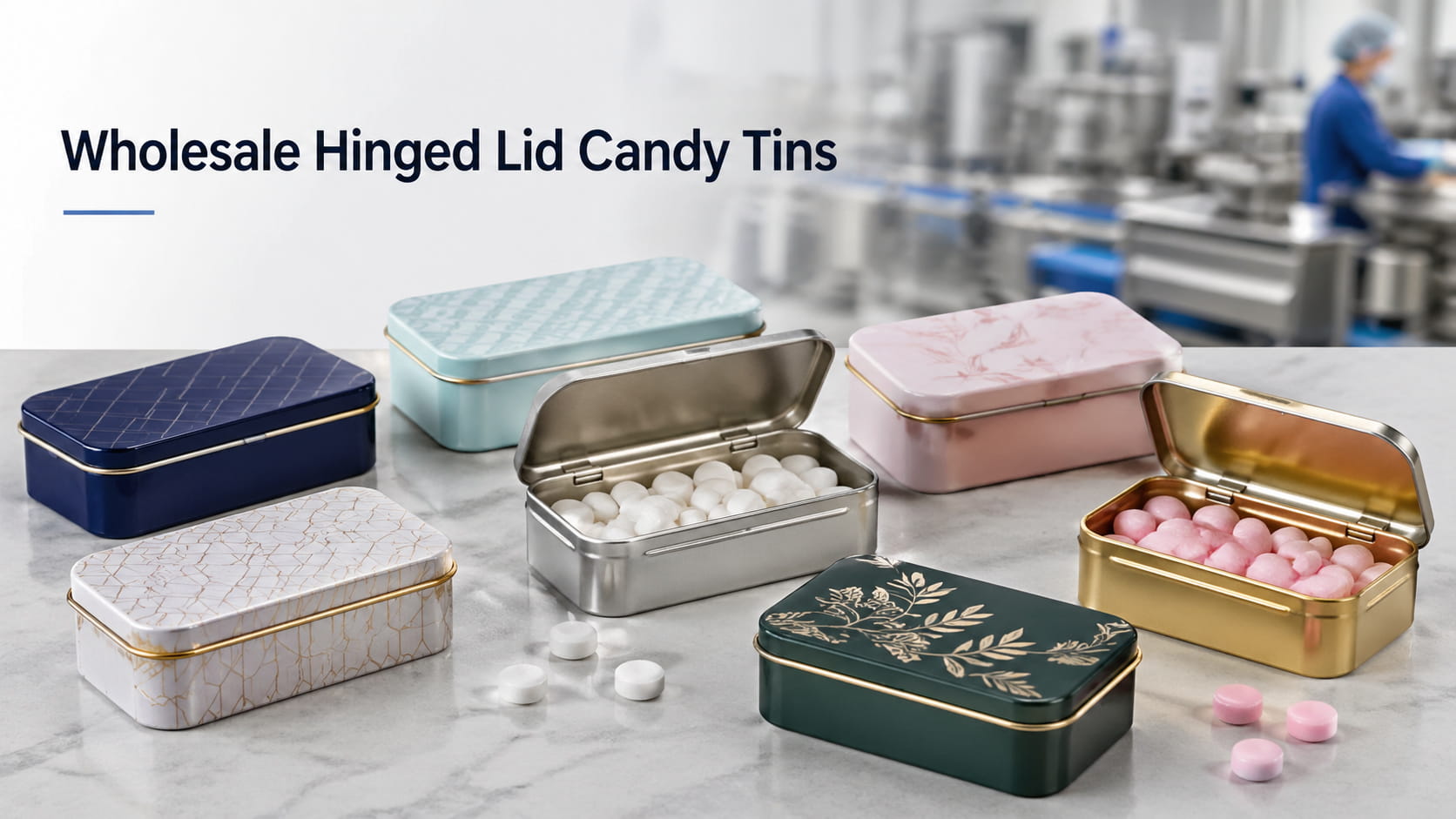
You don’t want your customers struggling with a lid that won’t open.
You also don’t want them holding a tin with a wobbly hinge that feels cheap.
The hinge is not a decorative detail. It is the part your customer touches again and again.
For hinged lid candy tins, the user experience depends heavily on the lid. The lid should open smoothly. It should close properly. It should not be too tight. It should not be too loose. The hinge should stay aligned after repeated use.
Does this sound familiar?
You approve a sample. It looks fine. Then mass production arrives, and some lids are not level. Some hinges feel loose. Some tins do not close neatly.
This usually happens when the supplier does not control the forming and hinge assembly process carefully.
Common hinge problems include:
When you check samples, don’t just look at the logo.
Open the tin. Close it. Repeat it. Hold it from different angles. Check whether the lid sits flat. Feel the opening resistance. Look closely at the hinge area.
If you are sourcing wholesale mint tins with hinged lids, this step is even more important. Mint tins are often used daily. Customers may open and close them many times. A weak hinge makes the whole product feel low quality.
In our factory, hinge inspection is not only about appearance. We check lid alignment, opening smoothness, closing stability, and edge condition. A small hinge problem in production can become a big brand problem after delivery.
A good hinge makes the tin feel reliable.
A bad hinge makes the brand feel cheap.
Honestly, this one causes a lot of arguments.
Your artwork looks perfect on a computer screen. But metal is not paper. Metal reflects light. Coatings affect color. Glossy and matte finishes change the visual result. Embossing can distort fine lines.
So no, your tin may not look exactly like your PDF file.
That does not mean the factory did something wrong. It means metal printing needs proper technical control.
Before you send artwork, you should understand a few things.
Small text can become unclear after printing and forming. Fine lines may lose sharpness. Large solid color areas may show slight variation. Metallic backgrounds can make colors look different. Pantone colors need clear confirmation.
You should discuss:
Here’s the thing: if your brand color is important, do not rely only on screen approval.
Ask for a printed sample or color proof.
A professional custom candy tin manufacturer should review your artwork before production. We should warn you if your logo is too close to the edge, if the text is too small, or if embossing may affect the design.
You do not want to discover these problems after 20,000 tins are already printed.
We have seen buyers send beautiful artwork that works well on paper but not on tinplate. When we suggest changes, we are not trying to make the design boring. We are trying to make sure it can be produced cleanly and consistently.
Good printing starts before the printing machine runs.
Everyone wants a good price.
We understand that.
But if you only compare unit price, you may miss the real cost.
A cheaper tin can become more expensive if the quality is unstable, cartons are weak, hinges fail, printing needs rework, or the supplier cannot provide the right documents.
Have you ever had a shipment arrive with half the boxes dented?
That is not just a packing problem. That is a sourcing cost problem.
When you compare quotations, do not only ask, “How much per piece?”
Ask what is included.
You should compare:
Wait, there’s more.
Sometimes two suppliers quote the “same size” tin, but the details are not the same. One may use thinner material. One may use weaker cartons. One may not include food-contact testing. One may not inspect hinge performance carefully.
The number on the quotation sheet does not tell the whole story.
For brand owners and importers, total landed cost matters more than unit price. A slightly better tin with stable quality may protect your launch schedule, reduce complaints, and make repeat orders easier.
When a buyer pushes only for the lowest price, factories usually have only a few places to reduce cost: material, printing control, inspection time, or packing strength. But those are exactly the areas that protect your final product.
A low price is good only when the quality still works.
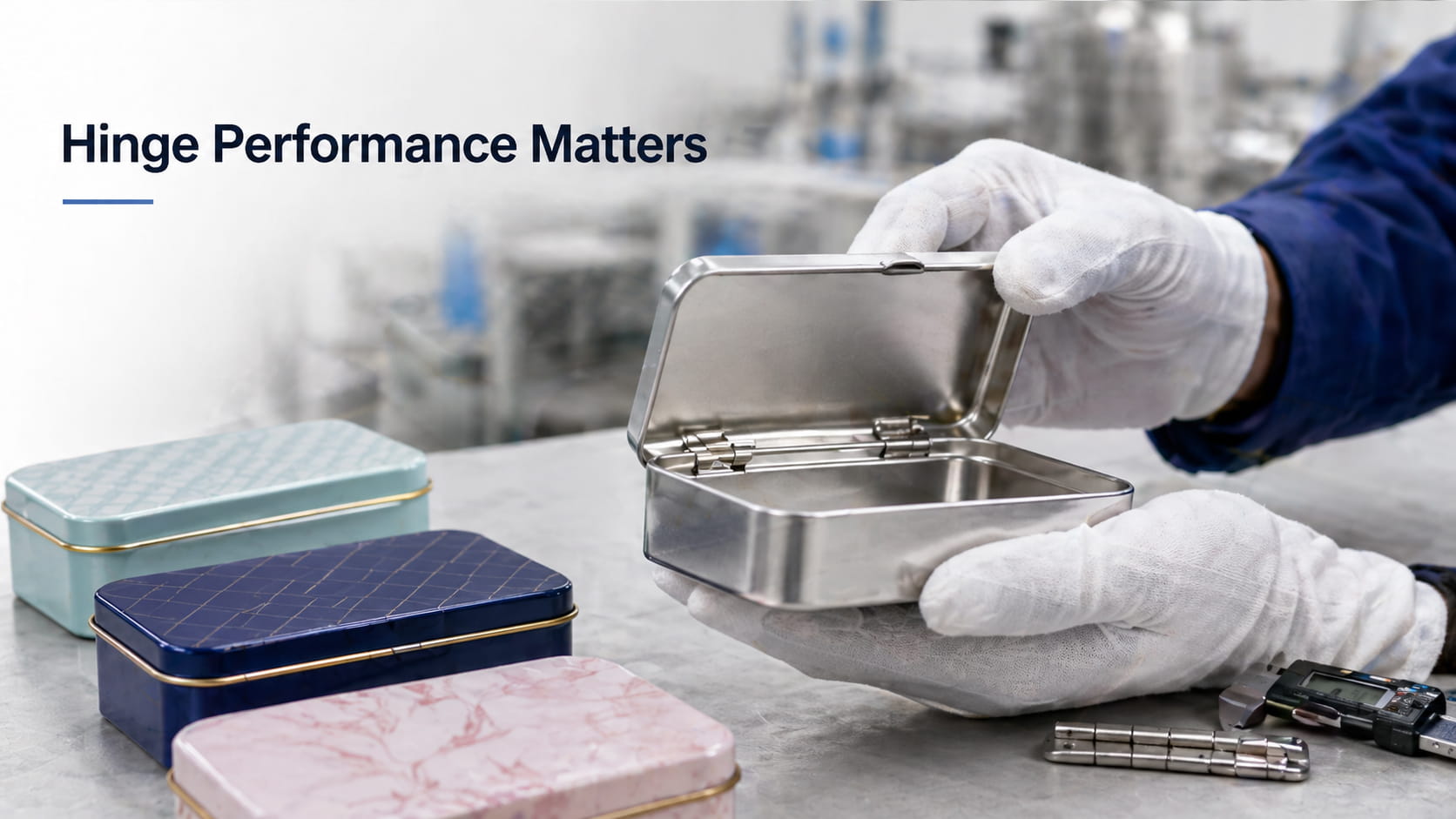
A tin does not live alone.
It has to work with your product, your filling process, your retail shelf, your warehouse, and your shipping route.
This is where many buyers underestimate the project.
They approve the tin design. It looks great. But then the filling team says the lid slows down packing. Or the retail team says there is no flat space for a barcode sticker. Or the logistics team finds out the cartons are too weak for sea freight.
Does this sound familiar?
Before production, ask yourself:
These questions are not small details.
They affect your cost, speed, and product condition.
For example, a beautiful glossy tin may scratch if packed too tightly. A delicate embossed lid may need extra protection. A carton that is fine for local delivery may not survive export shipping.
In our factory, we look at the full packaging chain. Not just the tin itself. We consider how tins are separated, bagged, arranged, boxed, and protected.
That is especially important for export orders.
Many dents do not happen during production. They happen after production, during packing, loading, or long-distance transport. Stronger packing may cost a little more, but it can save you from a very expensive complaint.
Good packaging is not finished when the tin is made.
It is finished when the tin arrives safely.
Samples can be misleading.
A sample is usually made with extra care. Mass production is different.
In mass production, thousands or tens of thousands of tins go through printing, cutting, forming, hinge assembly, inspection, and packing. Small variations can happen. That is normal.
But you need a clear quality standard before production starts.
Otherwise, you and your supplier may have different expectations.
You may think a tiny scratch is unacceptable. The factory may think it is within normal tolerance. You may expect perfect color matching. The factory may allow slight deviation. You may care about hinge tightness. The supplier may only inspect appearance.
This is how disputes happen.
Before mass production, define your standard for:
Here’s the thing: quality is easier to control when everyone agrees on the standard before production.
Ask for a pre-production sample. Confirm the artwork. Confirm the material. Confirm the packing method. Ask for production photos if needed. For large orders, consider third-party inspection or factory inspection before shipment.
A reliable custom candy tin manufacturer should be comfortable talking about quality standards. If a supplier avoids this discussion, be careful.
In our factory, we do not want quality standards to remain vague. Vague standards create problems for both sides. Clear standards help us produce better and help buyers receive what they expect.
A good sample starts the project.
A clear production standard protects the project.
Before you ask for a final quotation, prepare these details:
The more details you share, the better your factory can help you.
And the fewer surprises you will face later.
When you work directly with a tin box factory, you can talk about real production issues earlier.
You can ask about mold structure. You can confirm material thickness. You can check printing limitations. You can discuss hinge performance. You can plan export packing. You can request food-grade documentation.
That is much harder when every question passes through several trading layers.
For B2B buyers, direct communication saves time. It also reduces misunderstanding.
As a custom candy tin manufacturer, we do more than make tins. We help buyers avoid technical mistakes before they become expensive problems.
If you are sourcing wholesale mint tins with hinged lids, custom candy tins, or food grade metal packaging for a new product launch, your factory should be able to support you from design review to mass production.
Not just quote a price.
Not just send a catalog.
A good factory helps you think ahead.
A hinged lid candy tin is small.
But it carries your brand, protects your product, supports your retail display, and shapes the customer experience.
So don’t choose it only by photo. Don’t approve it only by price. Don’t assume food safety. Don’t ignore the hinge. Don’t skip packing details. And please, don’t start mass production without a clear quality standard.
You can avoid most sourcing problems by asking better questions at the beginning.
Need help developing custom hinged lid candy or mint tins?
Send us your product size, artwork, target quantity, and destination market. We’ll help you review the tin structure, printing method, food-grade material options, packing solution, and wholesale production plan before you place the order.
Because the best time to fix a packaging problem is before production starts.
Get The Latest Information And Special Offers


 IPv6 network supported
 English
 Français
 Deutsch
 Español
 Português