
In product development, the first decisions include the choice of packaging material. Before a brand can talk about printing, shape, lid structure or surface finish, it needs to answer a more practical question:
Which packaging actually works best for this product?
We use tin packaging, paper packaging, plastic packaging, aluminium packaging etc., in food, gifts, cosmetics, candles, promotional products and consumer goods. Every material has its obvious strengths, but there is no material that is best for every product.
The cookie gift set can include a decorative tin box. A plastic bag might be better for a snack refill. A paper carton may be needed for a cosmetic bottle. A beverage product might need an aluminium can.
The correct choice should consider product protection, cost, environmental impact, distribution requirements, shelf appeal, sales channel and whether the packaging is meant to be reused after purchase.
| Packaging Material | Main Strength | Common Limitation | Best-Fit Products |
| Tin packaging | Durable, reusable, premium, strong brand surface | Higher cost than paper or plastic | Tea, coffee, cookies, chocolate, gifts, cosmetics, candles |
| Paper packaging | Lightweight, printable, cost-effective | Weaker moisture and impact protection | Dry goods, retail cartons, sleeves, gift boxes |
| Plastic packaging | Flexible, lightweight, moisture-resistant | Lower premium perception and sustainability concerns | Snacks, refills, pouches, trays, sample packs |
| Aluminum packaging | Lightweight, corrosion-resistant, good barrier performance | Less common for decorative rigid boxes | Beverage cans, foil packs, trays, tubes, sealed food formats |
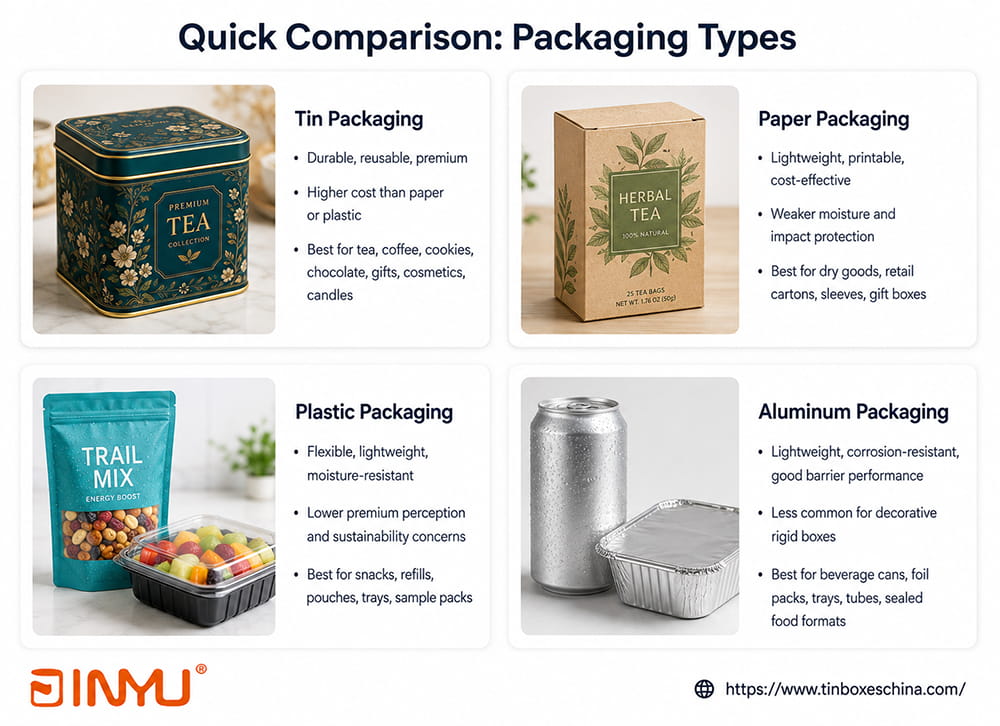
This comparison shows that packaging material should not be selected only based on appearance or unit price. It is better to match the material with actual product requirements.
Packaging has various jobs. It may need to protect the product in shipping, protect against moisture, reduce crushing, support food-contact requirements, provide shelf visibility, enhance gift presentation or convey brand value.
For low cost products weight and unit cost can be the priority. Shelf impact and reusability may be more important for premium gift items. For food products, barrier performance and freshness protection could be critical. The lowest possible packaging cost may be less valuable than promotional products for long-term brand visibility.
This is why the material selection process has to start with the product and not the material.
Tin packaging is commonly made from tinplate, a steel sheet coated with a thin layer of tin. Research on metal packaging materials also highlights the importance of material form, food applications, safety and recyclability in metal packaging systems.
Tea, coffee, cookies, biscuits, chocolates, candies, mints, cosmetics, candles, gift sets and promotional products are often packaged in tin boxes and tin cans.
The main advantage of tin packaging is its rigid shape. Compared to most paper cartons and flexible plastic packs, a tin box offers better protection against crushing and deformation. It also gives the product a more substantial physical presence in the customer's hand.
Tin packaging is also very decorative. It can do full colour printing, Pantone colour matching, matte or glossy varnish, metallic effects, embossing, debossing and special surface finishes. This makes it particularly appropriate for products for which the packaging is part of the perceived value.
Another important benefit is the reuse. Many customers keep attractive tins after the product has been eaten. You can turn a tea tin into a storage container. You can reuse a cookie tin at home. A promotional tin can sit on a desk or shelf for a long time. This offers tin packaging a better brand visibility than many of the disposable formats.
But tin is not always the most economical container. It may need higher MOQ, mould, longer sampling time, and more careful export packing. It is also heavier than paper or plastic, and this could add to the shipping cost.
Tin packaging is the best choice for products where durability, giftability, premium appearance, collectible value or reusable packaging matter.
Paper Packaging Folding cartons, paperboard boxes, rigid gift boxes, corrugated cartons, sleeves, labels, dividers and paper inserts. It is one of the most popularly used packaging material because of its printability, lightweight, flexibility and cost effectiveness.
Paper packaging can be used for retail cartons, secondary packaging, cosmetic boxes, dry food boxes, product sleeves and gift boxes. It is easy to print and can be tailored to many different shapes and structures.
Paper often has a familiar sustainability image, especially when recycled content or recyclable structures are involved. However, its actual recyclability can depend on coatings, laminations, inks, plastic windows and local recycling systems.
The biggest downside to paper is its durability . It is susceptible to moisture, bending, tearing and crushing. More fragile, oily, moist or premium products may require additional liners, coatings, trays or stronger outer cartons.
Paper packaging works best when the product requires a lightweight structure, print flexibility, cost control or secondary packaging. It is also suitable as a support for tin packaging such as paper sleeves, dividers, liners and instruction cards.
Plastic packaging includes pouches, trays, jars, tubs, blister packs, clamshells, shrink wrap and flexible films. Multilayer flexible packaging can improve protection and shelf life, but it can also create recycling challenges when different materials are combined.
Plastic is especially good for snack pouches, refill packs, candy bags, cosmetic jars, inner trays, protective inserts, product windows and sample packaging. Plastic is used in many food and personal care products because it seals the product, is lightweight, and protects it from moisture.
Plastic packaging is often functional as an inner component. cookie tins may have a plastic tray, tea tins may have an inner pouch, chocolate tins may have moulded trays to hold the product in place.
However, plastic often carries less of a premium perception than tin or rigid paper boxes. Sustainability concerns may also arise depending on the type of material, package format, local recycling infrastructure and consumer expectations .
Plastic packaging is best when moisture-resistance, transparency, flexibility, sealing, lightness or cost-effectiveness at high volumes outweigh premium presentation or long-term reuse.
Aluminium is commonly used for beverage cans, food trays, foil lids, cosmetic tubes, aerosol cans, pharmaceutical packs and sealed food formats. Aluminium foil and related packaging formats are often used when barrier protection, light weight and food compatibility are important.
Aluminium is lighter than tinplate and is commonly used in packaging formats that require sealing, high-volume production, or lightweight metal performance. It is particularly used for packaging food, beverage, personal care and pharmaceuticals.
The flip side is that aluminium is often more category-specific. It's often not the first choice for decorative rigid gift boxes, cookie tins, tea tins, or collectible packaging. Aluminium can also dent more easily in some thin-wall formats, depending on thickness and construction.
Aluminium packaging is best used when high volume production, sealing, barrier performance and lightweight metal are more important than decorative box structure.
| Packaging Need | Better Material Direction |
| Premium gift appeal | Tin packaging or rigid paper box |
| Strong rigid protection | Tin packaging |
| Lightweight retail packaging | Paper packaging |
| Moisture resistance | Plastic or aluminum |
| Product visibility | Plastic or window structure |
| Reusable packaging | Tin packaging |
| Low unit cost | Paper or plastic |
| Beverage packaging | Aluminum |
| Decorative collectible packaging | Tin packaging |
| Secondary outer packaging | Paper |
| Inner tray or product positioning | Plastic or paper |
| Long-term brand visibility | Tin packaging |
This table is a good starting point, but the final decision should still be based on product type, sales channel, order quantity, budget and brand positioning.
Tin packaging is strong for food packaging. It is used for dry food gifts like tea, coffee, cookies, biscuits, chocolates, candies and mints. Paper is good for the outer carton and sleeves. Plastic is often needed for sealing, moisture protection, inner bags or trays. Aluminium is good for beverage cans, foil packs, trays and sealed food formats.
Tin packaging is a great option to consider when the package should feel durable, reusable, collectible or seasonal for gift packaging. Paper gift boxes are generally lighter and cheaper, especially for short-term or lower cost gift packaging. Plastic is normally used as an inner component, not the main premium gift package.
Cosmetic Packaging Paper cartons are generally used for outer boxes, and plastic and aluminium materials are mostly used for bottles, jars, tubes and refills. Tin packaging is ideal for solid perfume, lip balm, salve, soap, cosmetic gift sets, travel kits and promotional beauty tins.
When a brand wants longer visibility, tin packaging is useful for promotional products. The customer could hang on to a reusable mint tin, candy tin, stationery tin or event gift tin long after the campaign is over. Paper and plastic may be more suitable for inexpensive short-term promotions.
Packaging cost is more than the per unit cost. Brands should also consider tooling, printing, finishing, inserts, liners, packing, shipping weight, risk of damage, storage space and perceived value.
A paper box might be cheaper but you might need to add more protection for fragile products. Plastic pouches can be efficient, but not necessarily lend themselves to premium positioning. A tin box can be more expensive but can add gift value, shelf appeal and reuse potential.
And we also need to think about sustainability. Tin packaging can be recyclable and may be reused by consumers when the design is durable, attractive and useful enough to keep. However, the environmental benefit of reusable packaging depends on actual reuse behaviour and the number of reuse cycles. Aluminium is recyclable and suitable for many closed loop systems, especially beverage cans.
A responsible packaging decision must balance the environmental impact with the protection of the product. Another way to create waste is with packaging that does not protect the product.
In many real projects, the best packaging system is not built on a single material. Combining materials can improve protection, presentation and usability, but it should also consider separation, recyclability and end-of-life handling.
A tin box could have a plastic tray to hold the chocolates in place. A tea tin may include an inner pouch to preserve tea. A cookie tin could have paper cups or dividers for presentation. A cosmetic set may consist of a tin outer box with paper cards and moulded inserts. An export carton may protect the finished package during international transport.
Every material has a role. The outer packaging builds brand equity and shelf appeal. Protects product with inner material. The insert helps with presentation. The shipping carton protects the finished package during transit.
“Brands need to stop asking what material is always best and ask instead what material combination best solves the full packaging requirement.”
If the product needs to be durable, presented in a premium way, reusable, decorated with print, suitable as a gift or collectible packaging, choose tin packaging.
Paper packaging Use when you need: • Light structure • Print flexibility • Cost control • Secondary packaging • Simple retail display
If the product needs to be waterproof, flexible, transparent, sealed, lightweight or cost effective in higher quantities, then plastic packaging is the way to go.
Opt for aluminium packaging when the product demands light metal, barrier performance, beverage compatibility or a format suitable for aluminium production.
The best material is not always the strongest, cheapest, lightest, and most decorative. It is the material that meets the actual needs of the product.
Tin packaging is better when durability, reusability, premium look and gift value are important. Paper packaging is better when lightweight structure, low cost and print flexibility are the main priorities.
The tin packaging typically offers better rigid protection and a more premium reusable feel. Plastic packaging often offers better moisture resistance, transparency, flexibility, sealing and low-cost high volume packaging.
Tin packaging is often better for decorative boxes, gift tins, cookie tins, tea tins and re-usable packaging. Aluminium is often better for beverage cans, foil packs, trays, tubes and lightweight sealed formats
It depends on what type of food. Tin packaging is good for dry food gifts such as tea, cookies, chocolates, candies and coffee. Plastic is good for sealed pouches and moisture protection. Paper is fine for outer cartons. Beverages, trays and barrier packs are often made of aluminium.
Yes. Many tin packaging projects use paper dividers, paper sleeves, plastic trays, inner pouches, liners or export cartons. The combination of materials often results in a more practical packaging system.
Brands should consider product protection requirements, moisture sensitivity, shelf appeal, cost, shipping weight, sales channel, brand positioning, sustainability goals and whether the package should be reused or discarded.
This article is based on practical packaging experience and supported by selected research on food packaging functions, metal packaging, paper-based packaging, flexible plastic packaging, aluminium packaging, packaging sustainability, and reusable packaging systems.
Get The Latest Information And Special Offers


 IPv6 network supported
 English
 Français
 Deutsch
 Español
 Português