
In March every year, a familiar situation repeats itself.
Tea brands are finalizing new blends, updating packaging visuals, and preparing for mid-year launches.
Artwork files are approved. Target quantities are roughly set.
Then one question suddenly comes back — often later than it should:
For wholesale sourcing, real cost control doesn’t happen at the negotiation table — it happens at the design stage, when the right choices are made before production even begins.
For buyers sourcing tea tins wholesale, understanding these cost drivers early is the difference between paying for value — and paying for avoidable complexity.
Tinplate thickness directly affects material usage, forming pressure, and shipping weight.
A difference of 0.02 mm may look minor on a drawing, but across a full container load, it adds up quickly.
For bulk tea tin packaging, thicker material only makes sense when it solves a real problem — such as deformation risk or stacking strength.
Otherwise, it often becomes a hidden cost with no visible return.
How we usually help:
During specification review, we compare thickness options against actual load and transport conditions, rather than defaulting to the thickest option “just in case.”
Round tins remain the most cost-efficient format for tea packaging.
Once designs move into square, rectangular, or stepped structures, tooling and forming complexity increase.
Cost-impacting elements include:
For custom tea tins wholesale, structure should serve a purpose — sealing, stacking, or brand recognition — not exist purely for visual novelty.
How we usually help:
At the design review stage, we flag structural features that increase tooling or forming cost and propose simplified alternatives where function remains unchanged.
Printing is one of the most common areas where budgets drift.
Full CMYK offset printing allows flexibility, but costs rise with:
Many buyers assume more colors mean better results.
In practice, controlled color strategy often delivers cleaner branding at lower cost.
This is why, during our design audit process, we provide a “cost impact overview” — highlighting how different color and printing choices affect unit pricing before artwork is finalized.
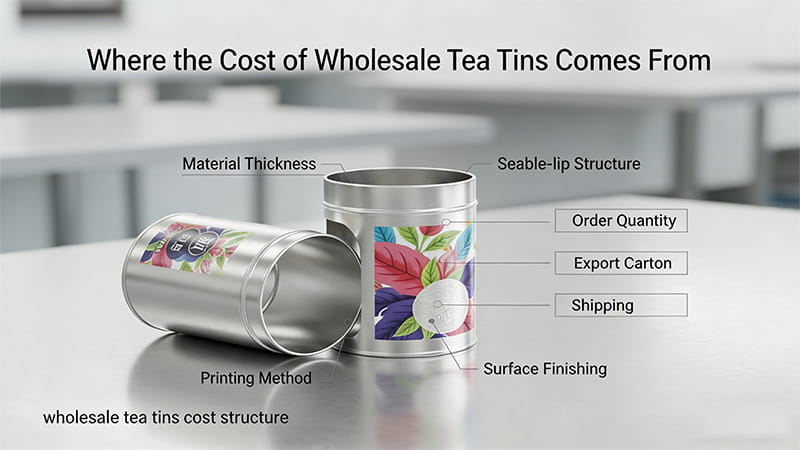
Finishing techniques define shelf appeal, but they also stack costs quickly.
Common options include:
For private label tea tins wholesale, not every SKU needs the same finishing level.
Using premium effects selectively — for logos or focal areas — often achieves the same visual impact without full-surface processing.
How we usually help:
We separate “must-have” finishes from “nice-to-have” ones, allowing brands to allocate budget where it actually influences buying decisions.
Sealing performance affects both product quality and cost.
Upgrading to air-tight tea tin structures adds forming steps and material, but the cost increase is usually predictable and scalable at volume.
The mistake many buyers make is treating sealing as a late add-on rather than a core functional decision.
How we usually help:
We align sealing structure recommendations with shelf-life expectations, shipping distance, and positioning — avoiding over-specification or under-protection.
MOQ is only part of the equation.
What matters more is how efficiently production can be scheduled.
Larger, better-aligned orders allow:
In many projects, we recommend a “mixed mold scheduling” approach — producing multiple SKUs with the same tin specifications in one batch.
This spreads tooling and setup costs across the order and improves overall pricing.
Cost does not end with the tin itself.
Export carton design affects:
For international buyers, aligning carton strength with sea freight vs. air freight choices reduces both visible and hidden costs.
How we usually help:
We review carton structure together with tin specifications, ensuring packaging protection matches transport reality — not assumptions.
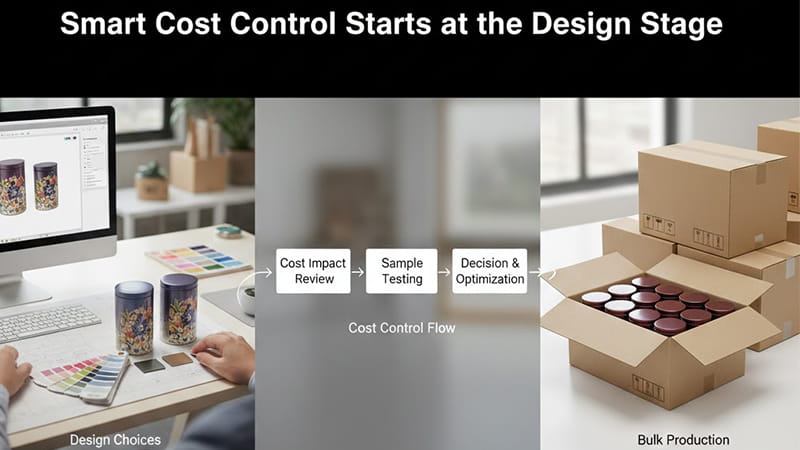
Before requesting a quote or finalizing artwork, it helps to pause and check:
This short review often reveals cost-saving opportunities without lowering product quality.
In recent years, more tea brands have changed how they evaluate packaging suppliers.
Instead of choosing based solely on the lowest quote, buyers increasingly prefer partners who can explain cost structure clearly and offer options, not just numbers.
As tea markets become more competitive, packaging decisions are becoming more strategic.
The brands that manage cost best are not those who spend the least — but those who understand where each dollar actually adds value.
If you are planning packaging budgets for an upcoming season, comparing total prices alone rarely tells the full story.
A design-based cost breakdown and value optimization review often provides far more clarity — and far fewer surprises — before mass production begins.
Get The Latest Information And Special Offers


 IPv6 network supported
 English
 Français
 Deutsch
 Español
 Português