
When premium tea and biscuit brands evaluate tin packaging, the real question is rarely whether the tin is durable enough. What they care about is how the pack communicates quality at first glance, how it feels in the hand, and whether that sense of quality still holds when the box is opened and used.
In practice, the difference between an ordinary tin and a premium one is not one dramatic luxury feature. It is usually the result of controlled printing, selective finishing, and structural details that feel purposeful rather than excessive. This article explains both sides of that result: how premium tin packaging is designed, and how it is actually made.
For gift-oriented products like tea and biscuits, packaging is part of the product experience. Before aroma, before taste, there is a moment of visual and tactile judgment. A premium tin should feel solid, reflect light in a controlled way, and communicate craftsmanship instead of decoration overload.
This is where printing and finishing become more important than many buyers first expect. Color alone rarely creates a premium result on metal. Premium packaging usually depends on how color, texture, and structure work together.
| Packaging cue | What the buyer feels or notices | Why it matters for premium positioning |
| Weight and rigidity | The tin feels solid rather than disposable | Reinforces value before the product is opened |
| Controlled light reflection | The finish looks intentional under store lighting | Helps the tin feel refined instead of cheap or overly glossy |
| Surface texture | The box feels designed, not generic | Supports higher perceived quality and brand memorability |
| Opening ritual | The lid and inner structure feel deliberate | Turns packaging into part of the premium product experience |
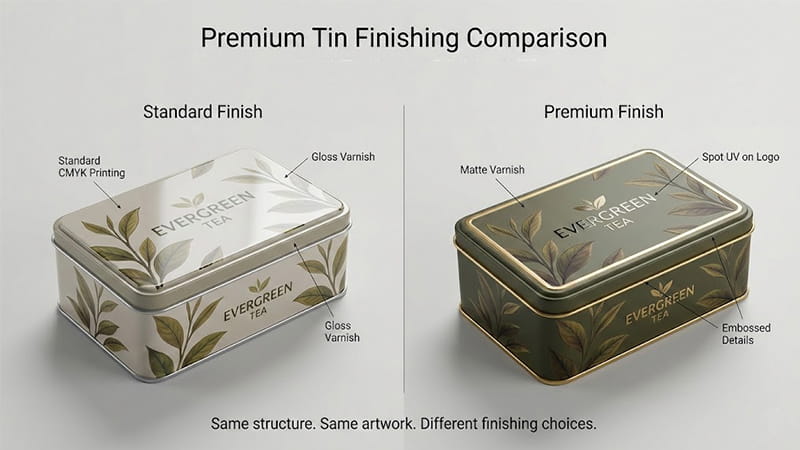
Standard CMYK printing on its own often looks flat on metal. Premium brands usually rely on finishes that interact with light and touch, not just color. The most successful results are often restrained: one primary finish, one focal enhancement, and enough contrast to make the design feel intentional.
| Technique | Best use case | What it adds | Main caution |
| Matte varnish | Minimalist or heritage-style tea and biscuit brands | Softer light reflection, more refined touch, lower glare | Can look dull if artwork and contrast are weak |
| Gloss varnish | Retail formats that need stronger color contrast | Sharper color, brighter shelf visibility, stronger surface protection | May feel less premium if used too aggressively |
| Spot UV | Logos, names, or controlled highlight zones | Selective contrast without decorating the whole tin | Loses impact if overused |
| Foil stamping | Brand marks, crest details, or gift-oriented packs | Focused metallic emphasis and stronger brand hierarchy | Works best in small areas, not full coverage |
| Embossing / debossing | Heritage brands, seasonal gifts, collectible packaging | Texture, depth, and stronger perceived craftsmanship | Requires precise tooling and depth control |
| Laser / holographic effect | Festive, trend-driven, or limited-edition projects | Multi-angle light effects and high visual drama | Not suitable for every brand identity |
One of the most useful technical points missing from many packaging articles is that tinplate does not behave like paperboard. The metal surface does not absorb water and solvent in the same way paper does. That changes how inks dry, how colors are built, and how stable the printed layer must be after production.
On tinplate, the printing result depends not only on the artwork, but also on adhesion, heat resistance, hardness, impact resistance, and drying control. A premium tin therefore needs both good design and a print system that can survive baking, forming, cutting, and handling.
| Printing surface | How it behaves | What that means in production |
| Paper or paperboard | Absorbs ink and solvent more naturally | Conventional print logic is more familiar and forgiving |
| Tinplate | Does not absorb water and solvent in the same way | Ink often relies on baking and controlled curing, not simple surface absorption |
| Tinplate after post-processing | May be cut, bent, stretched, or embossed | Ink film needs stronger adhesion and mechanical stability |
Tinplate has a metallic surface, often silver-white or slightly warm in tone. If color is printed directly without the right preparation, the result can look less bright, less clean, and less premium than the same design on paper. That is why white printing layers are so important in tin box production.
In practical terms, the white layer is often the visual foundation of the design. It lifts color brightness, improves contrast, and helps the final print look clearer and more accurate. On many projects, white needs to be applied more than once to reach the required opacity.
| White layer function | Why it matters | Risk if it is poorly controlled |
| Creates a neutral base under artwork | Improves brightness and color accuracy | Colors may look grey, dirty, or weaker than expected |
| Supports consistent image appearance across batches | Helps stabilize the design visually | Variation becomes more visible from tin to tin |
| Must tolerate repeated baking | Needs to resist yellowing and color change | The finished tin may look aged or inconsistent |
| Must bond well with primer and later color layers | Keeps the print stable through later forming | Peeling, scratching, or weak adhesion becomes more likely |
Premium tin printing should not be evaluated by color alone. On metal, color performance and durability are inseparable. Good ink for tinplate should offer not only strong visual performance, but also heat resistance, film adhesion, impact resistance, hardness, and resistance to light and later processing.
This is especially relevant when the printed tin will later be embossed, cut, bent, or assembled into a more complex structure. A finish may look attractive in a mockup, but premium packaging depends on whether it can hold up through the real production route.
| Ink requirement | Why it matters on tinplate | What it protects against |
| Heat resistance | Printing often passes through baking steps | Yellowing, instability, or color shift |
| Film adhesion | The print layer must stay bonded to metal | Peeling or weak surface performance |
| Impact resistance | Tins are handled, stacked, and shipped | Damage during forming or logistics |
| Hardness | The surface should not feel soft or fragile | Scratching and premature wear |
| Light resistance | Premium packaging must retain appearance over time | Fading or visual degradation on shelf |
One of the most technical but important points from the older printing articles is that premium tin printing is not only about “printing correctly.” It is also about drying correctly. Drying too fast and drying too slowly can both create visible quality problems.
| Drying condition | Typical production problem | Why it matters for premium results |
| Too fast | Poor ink transfer, lighter print, surface knotting on plate or rollers | The final print can look weaker, less even, or mechanically unstable |
| Too slow | Overprinting difficulty, scratching risk, reduced firmness, weaker adhesion | The finish may look good initially but fail during later handling or assembly |
| Controlled drying | Stable transfer and stronger process consistency | Improves both print quality and overall production reliability |
This is one reason premium tin packaging should not be judged only by a flat sample or static design proof. The real question is whether the chosen finish system remains stable through the whole production sequence.
Printing defines the first impression, but structure often defines the long-term experience. Many premium tea tins and biscuit tins look simple on the outside yet feel noticeably different once opened. That difference often comes from structural details rather than artwork alone.
| Structural detail | Where it works best | What it adds |
| Inner lid | Loose-leaf tea and higher-end dry goods | More deliberate opening ritual, added protection, stronger premium cue |
| Wire-buckle closure | European-style specialty tea markets and traditional dry-goods packs | Mechanical reliability, resealing confidence, traditional premium feel |
| Well-controlled embossing depth | Gift biscuits, heritage brands, collectible lines | Texture without surface distortion or fatigue |
| Minimal but precise closure upgrade | Projects where usage matters more than decoration | A stronger “used well” feeling over time |
One common mistake is to assume that premium packaging should include as many special finishes as possible. In reality, that often creates the opposite effect. Too many special processes can increase defect risk, make finishes interfere with each other, and raise production cost faster than they raise perceived value.
| Approach | What usually happens | Best use |
| One primary finish + one focal enhancement | Clear hierarchy, stronger brand message, more stable production | Most premium tea and biscuit tin projects |
| Many finishes layered without a clear purpose | Busy appearance, weaker message, higher risk of defects or incompatibility | Rarely the best premium route |
| Structure upgraded only where it improves real use | Better buyer experience without unnecessary cost | Projects where repeat opening and retention matter |
In most successful premium projects, brands choose one or two core enhancements and execute them precisely. Premium is usually the result of discipline, not accumulation.
When brands upgrade beyond standard tins, the most useful question is not “what special process can we add?” but “what single improvement will change perception most?”
| If the brand wants… | Most suitable upgrade | Why it usually works |
| A cleaner, more refined shelf look | Matte varnish + selective logo highlight | Creates restraint and contrast without looking flat |
| A more heritage or collectible feel | Embossing + controlled foil detail | Adds texture and craft cues without overdecorating |
| A stronger tea-opening ritual | Inner lid upgrade | Improves both function and perceived care |
| A bold festive or younger-market look | Laser or holographic effect used selectively | Delivers strong visual energy when the brand can support it |
| More reliable premium printing | White-base control + stable drying process | Improves color clarity and production consistency at the same time |
High-end tin packaging does not come from one material trick or one decorative process. It comes from consistent decisions across design, printing, drying, finishing, and structure, all aligned with how the product should be perceived and used.
For tea and biscuit brands, tin boxes remain unusually powerful because they can combine visual appeal, tactile quality, and long-term usability in one package. When those elements are handled thoughtfully, the tin stops being just a container and becomes part of the brand story.
When upgrading a tea tin or biscuit tin project, the most useful tin packaging supplier is not just one who can print well, but one who can explain how finishing choices, white-base control, drying behavior, embossing depth, and structural details will affect the final result. That is where premium positioning becomes repeatable rather than accidental.
 Related reading
Packaging printing is often treated as a single topic, yet in commercial practice it involves multiple technical layers that must work together to deliver the desired final result. In many projects, terms like printing processes, color systems, and surface finishing are used interchangeably, which can lead to misunderstandings in feasibility, quality control, and cost estimation......>> Read More
Tinplate printing belongs to the domain of specialty or metal printing, distinct from conventional paper printing in both process and equipment......>> Read More

Get The Latest Information And Special Offers


 IPv6 network supported
 English
 Français
 Deutsch
 Español
 Português