
A buyer requests a ‘100g tea tin’ and sends a picture of a shape they like. That gives us a target net weight and a design direction. To know the size, we still need to know what tea will be inside.
Tightly rolled tea, whole leaves, and blends with pieces of flower or fruit fill space differently. Add a sealed pouch and inner lid, and a tin that looked good on paper could become a challenge to pack.
If you have a new tea tin we recommend testing the capacity while the structure still has some give. A useful fill test tells you if the complete pack holds the correct weight, closes properly and can be filled consistently.
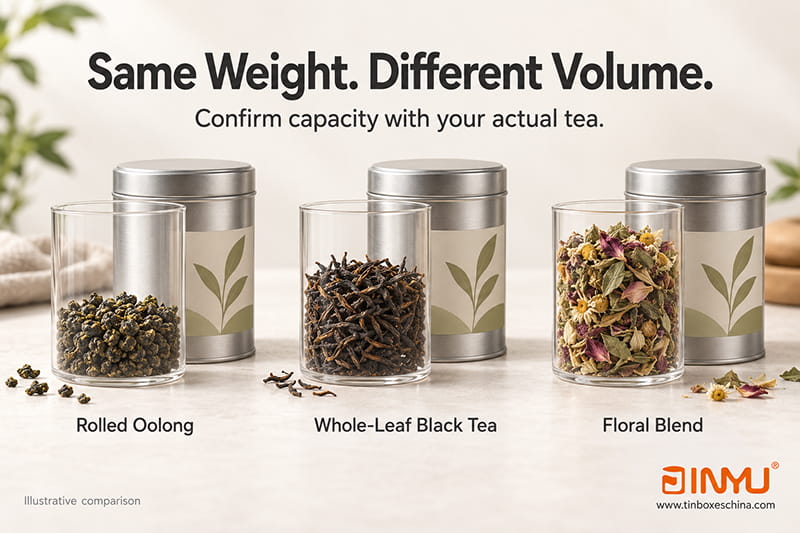
Bulk density is the weight of tea in a given volume including the spaces between the leaves. Holes of a different sort will be left by big loosely packed leaves than by small particles or tightly rolled shapes.
Jersey Fine Tea does this with same 3g amounts of small tea particles and whole leaf black tea. Even with that small weight, the difference is noticeable. See its tea grade comparison.
Green tea or black tea doesn't describe enough of the physical product to choose a tin. Look at the actual leaves, the complete blend. Teatulia’s advice on measuring makes the same practical distinction between bulky whole leaves, rolled leaves and larger ingredients in blends. Read Teatulia’s tips for weight and volume.
| Physical form | Choosing a tin: what to look for |
| Ball-shaped or rolled up leaves | See how the tea settles depending on how you want to fill it. |
| Leaves broken or cut fine | Record the particle size and the percentage of fines present in the sample. |
| Leaves whole; long, flat or loosely arranged | Check for opening clearance, fill height and damage during closing and scooping. |
| Mixes with flowers, herbs, fruit, spices | Try out a representative blend with the right proportions of each ingredient. |
Also note the supplier and lot number. If the next delivery has a markedly different leaf size or blend composition, a capacity decision based on one sample is less useful.
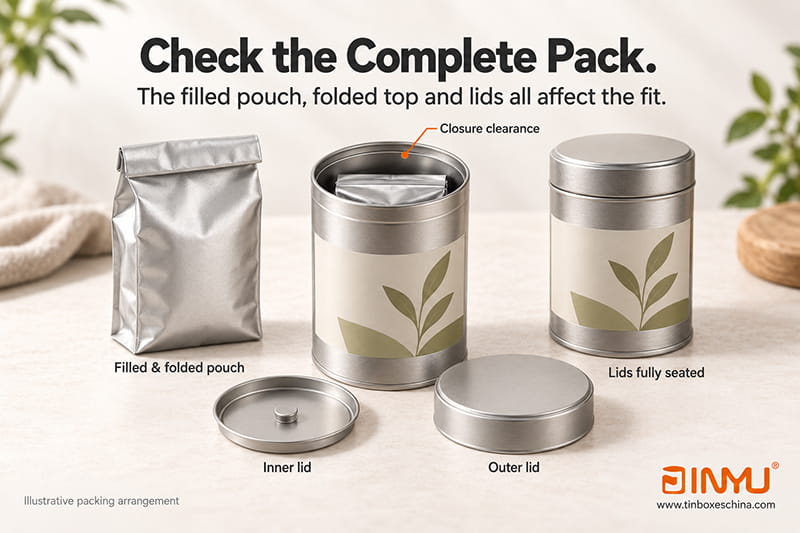
Knowing the outside dimensions helps when planning shelves or shipping boxes. Ask for the internal dimensions, the usable opening and the space available with the closure fully fitted for the tea itself.
The opening can be restricted by a shoulder or narrowed mouth. An inset lid takes up space beneath the lip. Be sure to check the maximum fill level including the inner lid for a construction like our double lid tea canister.
Ask the supplier if they can provide the volume in milliliters and how this was calculated. The terms “a brimful volume” and “a working fill volume” are used in different situations.
Check the inner pouch as well. Fill and seal it as it is intended to be. Fold the top as it is to be packed and put it in the tin. Seams, gussets and the folded neck affect the fit. Also verify that the filled pouch passes through the opening without force.
The headspace should comply with the requirements of the whole pack. Allow sufficient space for closure, normal variation in fill and easy handling. There is no universal percentage that can apply to all shapes of leaves and lid constructions.
If you are using bagged tea, separate the headspace in the sealed pouch from the space between the pouch and the tin. One change does not mean changing the other.
A volume estimate can help you to short list samples for a 50g, 100g or 250g pack:
Required tea volume (mL) ≈ intended fill weight (g) / [Measured bulk density (g/mL)]
Estimate density by weighing tea of known volume, under a defined filling procedure. Use a vessel large enough to allow the leaves to be freely suspended and repeat the measurement. Long leaves can snag across the opening of a narrow measuring cylinder, or be arranged otherwise than the tin intended.
Suppose, for example, that a sample measures 0.20g/mL by the method of choice. A 100-g fill would be on the order of 500 mL. This is assumed to explain the calculation not a normal density assigned to a tea variety.
500mL is the volume of the bulk of the tea. The complete pack still needs space for its pouch, any specified components and the clearance agreed. If you compare it with a working volume that already excludes those allowances, do not double-count them.
Published density figures can be helpful for an initial estimate. Important are their limits. Equipment maker Hapman points out that handling impacts bulk density, and gives its reference numbers as estimates. Bulk density guidelines for Hapman
Use tea from the bulk you are going to pack. Record SKU, supplier and batch. Ensure the sample contains the mix of leaves, flowers, fruit and other ingredients intended for the blend.
Do not select only the best looking leaves for the trial. The filler will get normal product variation. If you have a couple of batches, keep the results separate so you can tell if one is taking up more space.
Begin with two or three tin sizes that look promising. Have matching lids, actual inner pouches, proper scale, measuring tools and a record sheet at hand. Select the contact for use with clean, dry, suitable samples.
Include a scoop, insert or other accessory only if it forms part of the pack planned. If the packaging specification already calls for a desiccant or an oxygen absorber, insert the specified component in its designated location during the trial.
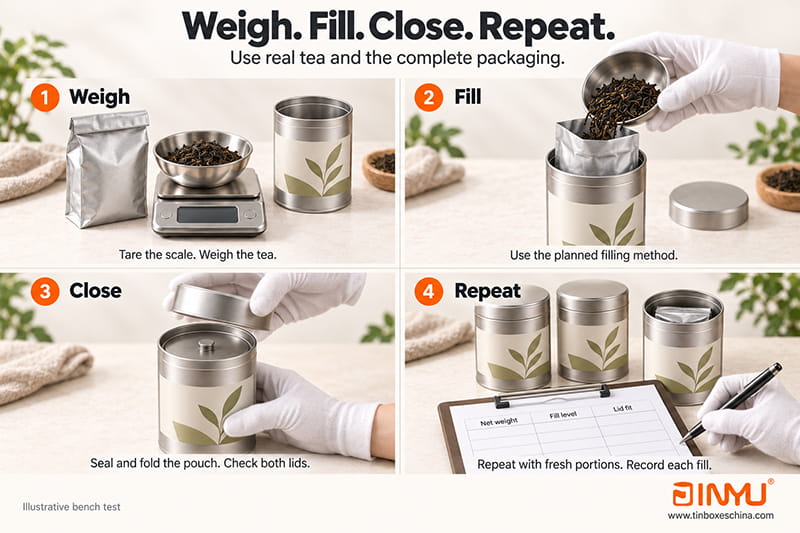
Check the scale with a suitable reference weight and deduct the tare of the packaging so that every recorded fill is the net weight of the tea.
Weigh out what you need and fill the pouch or tin how you want to use it in production. Keep the pouring method, funnel and any settling step the same.
For a first loose-fill test, let the tea fall into place without pressing it down. If the proposed process includes controlled vibration or settling, test and record separately. Look for leaf damage and volume change as well.
Record the fill level before closing. For uneven surface, put the highest leaves that can interfere with the lid.
Seal the pouch and fold Finish Fit the inner lid where applicable Close the outer lid normally. Look for leaves caught in the pouch, a fold against the lid, or a closure that’s not quite right.
Then open the pack like a customer would. Open it up, pour out some tea with the intended scoop or usual pouring action, and close it again. You can find the weight you need in a deep tin with a small opening but it will be hard to get to the last part.
If a tin requires some extra hand pressure to crush the contents into position then it should go back to the sizing review.
As a practical bench screening exercise, we recommend 5-10 separate fills per candidate size. This is a starting point for comparison, agree on a production validation plan with the filler
Use fresh portions if you can. The same leaves may be poured back and forth between containers, changing the sample by breaking up or separating the blend.
Every time, write down weight, fill level and closure result. See the highest filling level and the average. Ask the filler what weight range it’s meant to be working within and check the upper end, as well as the bulkiest representative tea samples.
Pack samples in the shipping arrangement intended and evaluate after handling typical of their distribution route. Agree any required transport simulation with the packaging or filling partner for a commercial launch.
Check for settling, pouch movement, new fines, damaged leaves and change in closure fit. Product may have escaped recheck net weight.
When we seal the pack the tea has to be just right. Any settling that takes place later in transit will not overcome the lack of space on the filling line.
Say a brand tests capacity by filling loose tea into a sample tin. The size looks sorted, the weight is just right and the lid closes. The production pack, however, employs a sealed pouch. When folded the inner lid stands above its proper position on its neck.
The next trial should compare the height of the folded pouch to the clearance of the closure. The problem may be solved by a different fold or width of pouch. Try another tin height or lid arrangement otherwise. Any change to the pouch must retain the required sealing and protective performance.
If this is found during sampling there is time to change the pack before ordering tooling or printed tins.
First confirm the net weight and inspect for loss. Settling by itself changes occupied volume, but not the amount of tea.
Compare photos of filling and coming. If the presentation is not good, try a different proportion of tin or a filling adjustment reproducible by the production process. Before assuming the change is harmless, check for breakage.
An insert should have a clear purpose, like securing a pouch or holding an accessory, not just be added. Check its cost, ease of assembly and impact on access before adding it.
A careful fill can conceal a clumsy opening or a shaky process. The funnel could snag on the tea, leaves could sit on the rim, or a pouch could take too long to insert and fold.
Run the candidate pack with the actual filler method prior to approval for bulk supply. Observe what occurs at running speed and if it is repeatable.
If the needed capacity is between two existing sizes, test both as complete packs. Remove any option that will not fit the intended fill range and will not close properly Of the options that pass Compare presentation, access, packing labor and shipping dimensions.
We recommend exploring the existing tooling early in the project. You may find a different diameter/height combo works better. When available structures cannot fulfilll product, fill or presentation requirements, new tooling is an option.
Test each tea individually for a collection. Consider a brand releasing rolled oolong, a whole-leaf black tea and a floral blend in matching tins. One structure could contain all three at different specified net weights. Two tin sizes might give a more consistent presentation if 100g is required in all SKUs.
Before you finalize the artwork and gift cartons, do that. A common visual style can still span more than one size.
The approved sample needs written specification for the purchaser, tin supplier and filler to use. Keep with the record the filled-pack photographs showing the pouch fold and the fully seated lids.
| Record | Information to keep |
| Tea sample | SKU, Supplier, Batch, Leaf form, Blend composition |
| Filling weight | Designed operating weight and range checked |
| Lids and tin | Reference internal dimensions usable opening and closure components sample |
| Inner packaging | Pouch specification, seal, fold and any agreed accessories |
| Filling Method | Equipment or manual method, pouring technique and any settling step |
| Repeat results | Net weights, filling levels, closing fit and observed leaf damage |
| Handling review | Shipping arrangement, settlement, pouch movement and condition post |
| Approval | Acceptance standards, date, sample reference, photographs |
Keep a reference sample where possible. Check the fit again when the physical form, blend, pouch, closure or method of filling of the tea changes. The validity of a previous approval is only for the time for which the conditions are comparable.
Take a representative 100g portion and measure the volume using the intended filling method. Select tins that can hold the whole pack. Then test the fit with real samples and the operating weight range of the filler.
The description needs a reference product and a filling condition. The stated capacity will depend on the type of tea used ask. Was an inner pouch added? Ask the way of fitting of the lid.
Multiply the volume of the available to the tea by its measured bulk density under the intended filling condition. Use consistent units: milliliters times grams/millilitre equals grams. Check the estimate in the real pack.
Use a settling step only if it is part of an agreed repeatable filling process and the tea is willing to accept it. Forcing the leaves into a smaller tin changes the condition being tested and can damage the product.
It can. Insertion and closure clearance is influenced by the width, seams, seal and folded top of the filled pouch. Test it in its finished packed condition with all the lids for which it is intended.
First, compare sample structures, and complete the relevant filling checks before locking into final tooling, artwork dimensions and bulk production. Then look for any changes to the product or packaging.
Send Jinyu the tea type and target net weight for a new loose leaf tea tin, along with photos or details of the available tea sample. Inner Pouch, preferred lid, Filling method, order quantity and destination market.
Submit your tea tin packaging brief and ask us to review suitable existing structures and the sample checks you need for your pack. If you can provide tea samples, please coordinate the sample quantity and delivery information with our team in advance.
Minimum custom printed production is 5,000 pieces per size & design. Confirm the structure chosen and the sampling schedule before confirming the production date.

Get The Latest Information And Special Offers


 IPv6 network supported
 English
 Français
 Deutsch
 Español
 Português