
Approve a gummy tin with actual product in the intended pouch and lid closed. A drawing may not show a thick fold under the lid, a seal snagged on a metal edge or a bag that requires too much manipulation to load neatly.
Those problems are easier to fix when the packaging is still being developed. Once the tins are printed and the filling line is booked, even a small change can affect a number of suppliers.
First, check the fit. Approval also has to include the pouch seal, product stability, transport, and the way customers open and reclose the pack.
The pouch serves as the main moisture and hygiene barrier for a sealed inner bag within a tin of gummy candy. The tin protects it, and sells the retail presentation. The test program must accompany the real product through the whole system from filling to delivery.
Start with a brief product overview (gummy type, surface coating, piece size, target net weight, desired shelf life and target market). Specify expected storage conditions and time between gummy production, conditioning and packing.
Even at the same pack weight, a sugar-coated ring and an oil-coated bear may require different checks. Rather than predicting that all products will develop these faults, use the following as prompts for the test plan:
| Characteristic of product | Question to be investigated | A useful observation |
| sugar or sour powder coating | Does loose coating get to the seal? | Coating loss and residue around seal following handling |
| Oil surface treatment | Does oil have an impact on filling or sealing? | Seal contamination and alterations in appearance of product or film |
| Unusual and large shapes | How much space does the filled pouch take up? | Maximum filled thickness, settling, lid clearance |
| Layered or filled gummies | Do the components stay stable together? | Changes in shape, texture and release of visible liquid |
| Miscellaneous | Does the mix stay acceptable in storage? | colour transfer, alterations in smell, and pieces sticking together |
Where applicable, water activity and moisture measurements should be provided by the confectionery producer. These are different properties. Moisture content is the amount of water, and water activity is the availability of water in the food. Conditions of measurement are important, especially temperature. FDA guidance on water activity explains the difference and why it is important to the stability of foods.
Get agreement on the acceptance criteria before test. “No unacceptable sticking” must mean the same thing to all. A useful evaluation might distinguish between pieces that can be freely separated, pieces that separate with gentle handling, and a solid mass that cannot be separated without damage. The product owner must determine which condition is acceptable, and how it will be assessed consistently.
List the components, indicating what touches the gummies and how the other materials are used. For the inner-bag route, this includes the pouch construction and any inserts in direct contact. Consider the tin and its coating in the light of intended use and any reasonably foreseeable transfer to the food.
Request from suppliers documentation identifying the material, intended food contact application, use restrictions and supporting tests if applicable. A report for a different coating or contact condition may not be applicable to the proposed application.
For the US, review applicable regulatory basis and conditions of use. According to FDA’s guidance, the status of a material is determined by the substances it comprises and the authorisations that cover their intended use. “FDA certified” is a generic description and does not give enough data for this review. FDA guidance on food contact compliance
For the EU, distinguish the general food contact framework from the material specific requirements. Regulation (EU) No 10/2011 relates to plastic materials and articles. It is not a general testing specification for metal tins and all coatings. Legislation of the European Commission on food contact
Direct pouring into a tin requires a check of food contact, coating compatibility, closure performance and shelf life. Getting a bag-in-tin approved is not the same as getting loose gummies approved in the same box.
Proposed pouch material, production representative gummies, intended sealing process and selected tin structure. Includes inserts, sleeves and other parts that may affect fit or handling.
For each sample, record the product batch, packing date, fill weight, pouch spec, sealing settings and tin model. Differentiate between material and process versions.
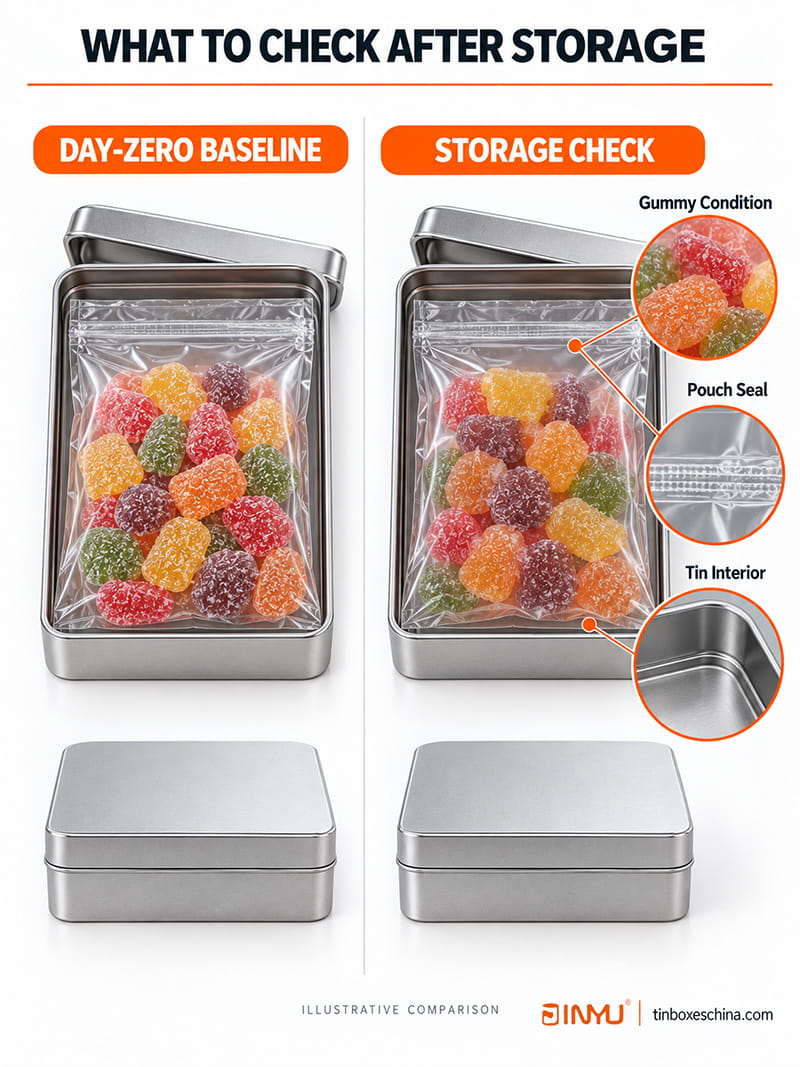
Take photos of the product and packaging prior to storage or test for transport. Record texture, surface condition, colour and aroma of the gummy and any relevant measurements agreed by the quality team. At this point, check the seal and lid fit too.
An approved existing pack is a useful comparison if tested under the same conditions. This helps the team to determine if a change is specific to the proposed packaging.
Arrange sample sizes by test method, variability among lots, and inspection intervals. Don't open all packs at once, some unopened packs should be kept for later checks and reserves to investigate unexpected results. The same pouch being opened repeatedly alters its storage exposure.
Filled-pouch dimensions are a good place to start in reviewing a gummy tin at Jinyu. The net weight doesn’t tell the whole story, in terms of space needed.
Fill to target weight and check lower end of agreed filling tolerance. Allow the product to settle with the process to be used. Measure the pouch with its actual seal margin, zipper and remaining air Squeezing it flat for measurement can hide a fit problem.
Then carry out the complete loading operation:
Fold or position the pouch as the packing team will in production.
Put it in the tin with any insert or support it may have.
Close the lid with the usual assembly motion.
Open the tin again and look for trapped film, seal pressure and contact marks.
Take off the pouch and see if the customer can get a good grip.
Watch the corners and the lid channel. It can be difficult to consistently load a pack that has to be hand arranged each time at production speeds. Extra space is something to think about too, if the pouch moves enough to rub against the tin or disturb the presentation.
Take a 250 g pack of sour gummy as an example. The empty bag fits the selected tin but when full, the top fold of the bag lies under the lid. When you push the lid down it pushes the fold against the seal. Before choosing a deeper tin, the team may look at the proportions of the pouch, the settling method and the folding position. Any re-arrangement would require another filling trial and the proper seal and handling checks.
This example shows why the pouch supplier, the packer and the tin manufacturer should look at the same filled sample.

Request barrier data for proposed film structure including test method and conditions. The performance of the moisture barrier is evaluated by the water vapour transmission rate (WVTR). The oxygen transmission rate, or OTR, may also be important if the formulation contains ingredients that are sensitive to oxidation.
Compare results produced under similar conditions. Temperature and humidity printed on a film report describe that measurement, but don’t automatically define the storage program for your gummies.
Also the completed pouch has to be evaluated. The flat-film result cannot reflect the features introduced by sealing, folding and loading. This is why Labthink’s advice on packaging for sweets is to test both the material and the finished package. Testing of materials and finished packs
Carry out a filling trial representative of the planned equipment and operating conditions. Check for sugar, sour powder or oil in the seal area, wrinkles, uneven sealing and damage of the film. Log temperature, pressure and dwell time so that the result can be traced back to the process used.
Different questions are answered by seal strength and leakage. A strength test measures the force at which failure occurs in a sealed specimen and notes the mode of failure. ASTM F88/F88M provides a way to do this. Agree on the acceptance range for the selected material and application, with a consistent test setup. ASTM F88/F88M seal strength method
Leak testing is the search for a path by which the pack can lose or flow in gas or liquid. The method must be suitable for the pouch and its contents. For example, ASTM D3078 deals with gross-leak detection in flexible packaging with headspace gas and explicitly states that small leaks may not be detected. ASTM D3078 bubble emission method
Obvious defects are found by a squeeze check or by an apparently sound seal. Neither provides long term barrier performance. The quality team will select complementary checks and document the limits thereof.
Once the candidate pack is well defined, start the storage work. In the launch schedule, make time for it, with structural development and other testing where appropriate.
Real time testing is carried out in the intended storage conditions of the filled pack. Accelerated studies or temperature stress screens can be used to find weaknesses sooner, but they have different uses to the results. A severe heat exposure may show a deformation, but does not give a valid way to calculate months of normal storage.
Any prediction of shelf-life based on accelerated results must be substantiated on the product and packaging, and the model must be supported by evidence. The food producer’s quality team should decide on the program and the evidence required for release.
Compare the unopened test packs to the initial records at each interval. Check separation of gummy, firmness, elasticity, shape, coating retention, colour and aroma. Examine the pouch for leakage, abrasion, delamination or seal changes and the tin for staining, coating damage and lid movement.
If condensation occurs, note the location and temperature history. Moisture on the outside of the pouch and moisture in the pouch raise different questions. A humidity sensor located between the bag and tin does not directly measure the water activity of the gummies.
Check for sticking across the product and process and also the packaging. Analyse the gummy batch, conditioning time, surface treatment and heat exposure in relation to the seal and barrier results. The cause may remain unresolved by automatically switching to a higher-barrier film.
The program should also include the food-safety assessment and any microbiological work identified by the producer. Acceptable appearance and texture are not sufficient to determine product safety.
The shipment of empty tins to the filling plant shall be separate from the delivery of the filled retail product. The contents, weights and protective arrangements can vary widely.
Use intended carton, tin count, dividers, gross weight and pallet arrangement for wholesale distribution. For direct-to-consumer orders, test the parcel in the same condition customers will receive it, including the outer box and cushioning.
A packaging laboratory can help in the selection of an appropriate combination of conditioning, vibration, shock and compression tests. ISTA distinguishes between early screening procedures and simulations for specific distribution environments such as parcel delivery and unitised loads. The selected procedure should be appropriate to the shipment being evaluated. ISTA test procedure guidance
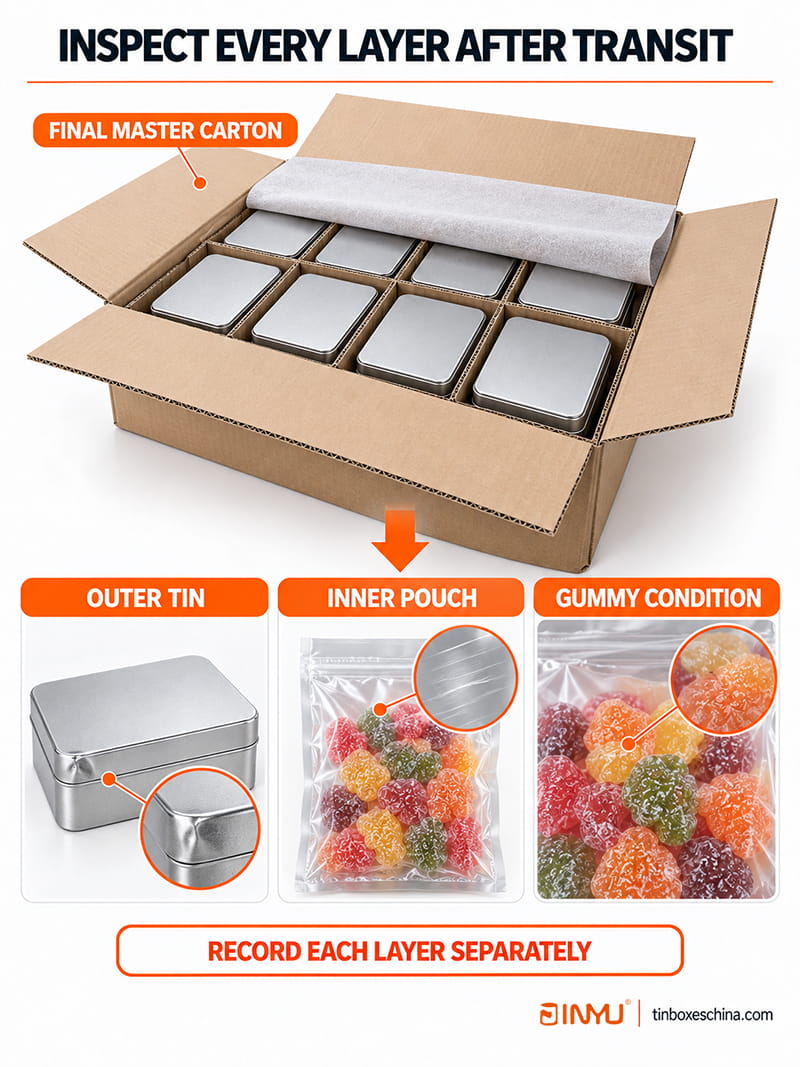
Before disassembly the complete assembly is inspected at testing. Photograph shifted contents, lifted lids and deformation of carton. Take out the pouches and inspect the contact points, the seal edges and the gummy condition.
Log damage level at each level. A dented tin may contain an intact pouch, and a neat tin externally may hide film abrasion. The retail presentation and the safety of the food also call for a decision against the agreed criteria.
If the distribution route includes significant temperature exposure, agree how that exposure fits into the test sequence. Just because the gummies have passed mechanical testing doesn’t mean they will be able to withstand the heat conditions of the route.
Get people outside the development team to open the finished sample. Watch for places where they stall or press.
Can they peel off the tamper label, grab the tin lid and pull the pouch out? Does the tear notch open the bag cleanly? Can you get to the zip when the top is off? Inspect exposed edges and pinch points during normal handling, as well.
For a sharing pack, conduct an independent opened pack assessment using a defined pattern of opening, removal of portion and reclosure. Do not combine these results with shelf life unopened results. You need proof of how a zip behaves after it’s used.
Intended: Approve printing on metal substrate and finish. Check how those surfaces look after packing and transport. Have an agreed physical reference for colour and appearance. Add label legibility. Variable-code space. Any areas where tins or inserts rub.
These checks can help to see if a technically acceptable pack is also practical to fill, sell and use.
Consolidate the results prior to issuing the final packaging specification.
Each decision should be associated with a sample version and a recorded test with open issues clearly assigned.
| Review area | Evidence for retention | What approval shall establish |
| Design: Filled pouch | Contact photos filled dimensions, loaded records | The fill range loaded and closed in within approved limits |
| Seal and barrier | Data on materials, process parameters, strength, and leakage results | The selected pouch and sealing process are to their specifications |
| Stability of product | Baseline and interval results with required evidence on food safety | The claims of declared storage and shelf-life are sufficiently supported |
| Distributions | Pack setup, testing conditions and post-test examination | Damage is within agreed criteria for that shipping format. |
| Consumer appearance and use | Opening observations Reclosure results and print reference | The retail pack satisfies handling and presentation requirements |
Update project record with the result, report or photo reference, reviewer and date. Where visual references are being judged for appearance and the use of them is appropriate and approved, agree measurable limits.
Keep the final pouch spec, tin drawing, folding method, artwork and carton arrangement all together. Retain approved representative samples.
Later changes to the gummy formulation, coating, shape, fill weight, film supplier, sealing equipment or shipping route should trigger a review of which tests need to be repeated. Conformity to the approved specification is verified by routine production inspections and agreed sampling plans. These do not replace the original validation work.
In the system described here the barrier is a sealed inner bag. Other formats such as individually wrapped gummies or special direct fill containers require their own evaluation. Do not assume that the ordinary decorative tin will provide the necessary seal.
Possibly, but verify that the flavours differ in surface treatment, formulation, size or stability requirements. The quality team can determine whether grouping is justified and which variants are representative of the more demanding conditions.
Once materials are available, fit checks and initial filling trials can be done quite quickly. It takes longer to do laboratory testing, modifications and shelf-life work. The sample manufacturing lead time should be provided separately from the validation schedule.
Only when there is a valid scientific basis and evidence to support the prediction. The declared shelf life is not established by passing a short heat or humidity screen.
The approval of the confectionery producer, packer and packaging suppliers should be coordinated by the designated quality owner of the brand. Each supplier offers evidences for its part of the system; decisions about food safety and shelf life are made by the responsible food business.
For a Jinyu gummy tin project, please advise on the type of gummy and surface coating, target fill weight, filled pouch dimensions, preferred tin shape, destination market and order quantity. Fit review: A pre-existing, approved pack or a filled pouch works well.
We can review dimensions of tin, lid structure, pouch clearance, printing and packing arrangement before sampling. Your confectionery producer and packer will have to confirm the pouch requirements, the sealing process and proof of product shelf life.
Custom tin production begins at 5,000 pieces. Normally we require 7-10 days for samples, 25-35 days for mass production after sample approval. These are the manufacturing lead times. Provide separate allowance for the validation work your project needs.
Take a look at our candy and chocolate tin packaging selection or complete the inquiry form on our gummy tin product page.
FDA. Determining the Regulatory Status of Components of a Food Contact Material.
European Commission. Food Contact Materials: Legislation.
Labthink. Testing Control Solutions for Candy Packaging Quality.
ASTM International. F88/F88M: Seal Strength of Flexible Barrier Materials.
ASTM International. D3078: Determination of Leaks in Flexible Packaging by Bubble Emission.
International Safe Transit Association. Test Procedures.

Get The Latest Information And Special Offers


 IPv6 network supported
 English
 Français
 Deutsch
 Español
 Português