
A mint tin can be snapped shut with a reassuring click and not give any visible signs that someone opened it before. And a good fitting lid keeps the tin useful day after day. It doesn’t necessarily tell a customer this is the first open.
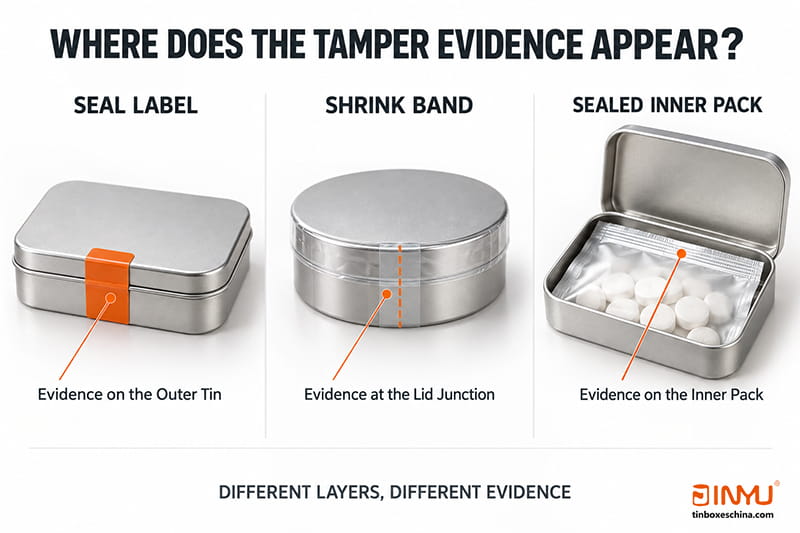
Seal labels, shrink bands and sealed inner packs can solve that problem, but they don’t all cover the same part of the package. Before you quote prices check what it is that the customer needs to look at, the outside of the tin, the pack that holds the mints or both.
Then, include the filling partner in the discussion. The seal must be applied to the finished product at the point of packing.
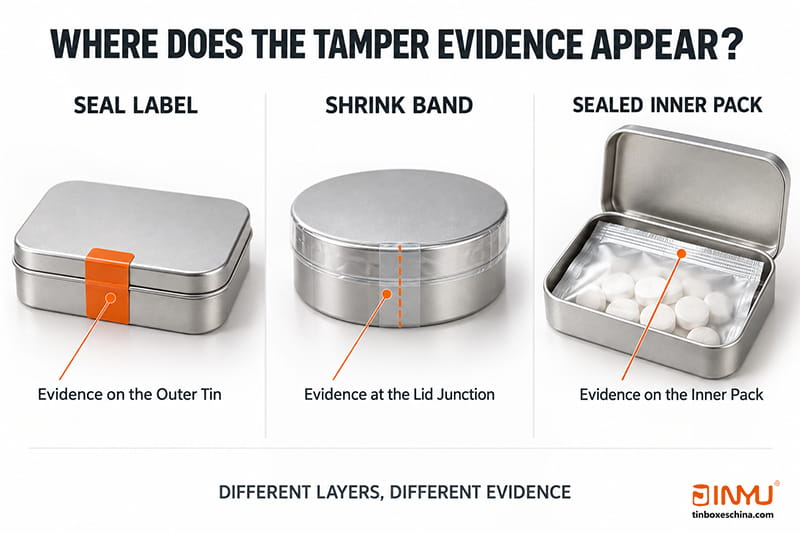
Tamper-evident packaging is packaging that is designed to provide visible evidence of opening or tampering. That’s different to making a pack impossible to get into. It also has nothing to do with keeping moisture out or closing the lid again.
An intact feature does not assure food safety for all. It cannot tell the customer how the mints were handled before being sealed up.
Comparison is a way to narrow down options, not a way to rank options from weakest to strongest.
| Approach | What can be audited by the customer | Significant limitation |
| Label with tamper-evident seal over opening | A specified tear, split, transferred design or other visible change. | A sticker may not be good evidence. Check where it is placed and how it sticks. |
| Shrink band around relevant lid to body junction | The existence and condition of a band that was supposed to break during opening | Close fit alone does not provide tamper evidence or moisture protection |
| Inner pouch sealed | Opening the tin lid, the original pouch seal and any damage to the opening | The bag may not have been opened, but the outer tin has been opened |
Where there is a requirement for external opening evidence and a separate product barrier, a label and an inner pouch may be used in combination. Each should have a defined purpose.
A label may occupy little space on the artwork, and it may be convenient for a filler with suitable labelling machinery. The useful question is what happens when the tin is opened?
Designs may include destructible materials, tear features and films that, when lifted, reveal a pattern. Adhesive strength is not just a matter of specification: the change you want must actually occur, and it must also be easy to see.
Avery Dennison’s technical bulletin on tamper-evident polyesters explains how certain VOID materials function and why performance is dependent on the substrate, application conditions and time allowed for the bond to develop. Test the chosen label on the finished printed tin, including its final varnish, not on a bare-metal sample.
Think of a shallow, hinged mint tin. A label on the front opening is on the queue for a trial, not a sure-fire approval. Check the actual opening movement, the available bonding area and the effect of placement variation. A label close to a seam does not mean that it is controlling that opening.
Keep samples that are in unopened and opened condition. Check for lifted corners, unclear evidence and damage to the printed finish.
Residue is a matter of choice. Some systems deliberately leave a message or pattern . Others are trying to leave the reusable tin cleaner . Ask the label supplier where the evidence will be stored and check that it is visible without making daily use awkward.
A narrow band about the lid junction, and a full wrapper are different constructions. Ask for a sample that shows exactly where the film is and what difference the lid makes.
For a round slip lid tin, inspect the junction of the lid and body. Include the corners, projecting details and actual lid movement in the sample trial for a rectangular or sliding tin. Form alone does not dictate fitness.
Agree a tear feature for customers to find and use. It should allow the first opening to be manageable without splitting the band in normal packing and distribution. Make sure the band applied leaves the important information readable and comes away from the container without a stubborn strip around the lid.
The trial should also include the heat process. Run the real pack full on the proposed film and equipment. The heat exposure of the mints, inner packaging and printed tin is not described by tunnel settings alone.
A partial band shall not be considered as a moisture barrier. Nor should it be used as a compensation for a lid that does not fit well. Recheck the lid once the band is removed.
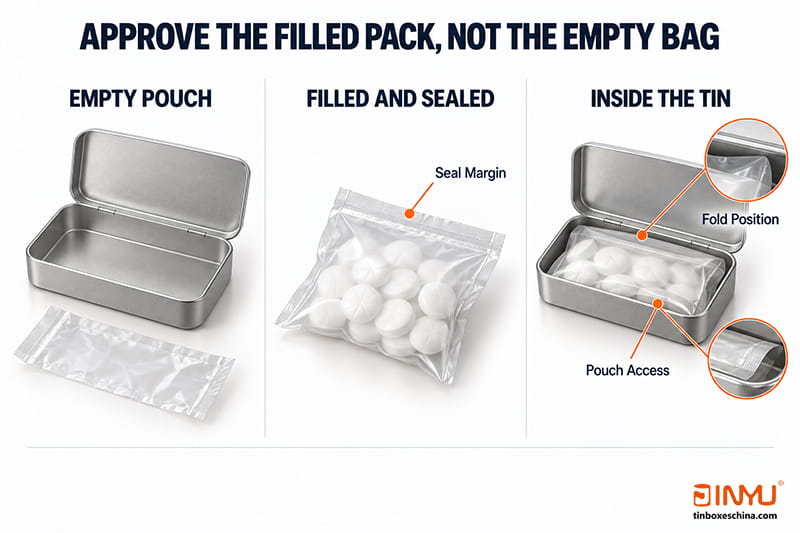
The sealed pouch allows the metal tin to go without any external label or band. The tradeoff is simple: The shopper can’t verify that inner feature until the lid is raised.
Define first opening indication for pouch. A folded bag or normal zip closure is not an original sealed edge. Sometimes pouches have a sealed section above a zipper that you can tear off. However, once the zipper is closed the original unopened state is not restored.
Barrier performance is a different specification. Request film and seal information appropriate for the mints and the storage conditions in which they will be stored. Just because a pouch has foil or is described as high barrier, don’t assume it has a longer shelf-life.
The bag changes the fit as well. Try it filled, folded and sealed in tin. Keep the seal margins out of the lid fitting area and provide adequate access for pouch removal. Our mint tin size guide explains why the loose-mint capacity is not what determines the size of a pouch-in-tin pack.
Another construction is a membrane sealed directly across the tin opening. It needs a proper sealing surface, and a compatible material and process. It is not a drop-in replacement for another bag. Selig’s advice on container sealing breaks down liners from seals, and why bonding material has to be compatible with the container.
Finally, you will decide if customers will continue using the pouch, or dump the mints into the tin. If they are emptied the loose product is no longer protected from the pouch.
To select materials, a sample of a flat label or an empty bag can be used. Approval is granted only for the complete pack produced as intended.
“Test two contradictory failures: an unopened pack that looks opened, and an opened pack that looks unopened after normal handling.
| Check | What to look at |
| First evidence of opening | If the change can be seen after opening, and if it remains visible when the lid is closed again |
| Standard distribution and storage | Accidental label lifting, band splitting, pouch damage or loss of legibility under agreed conditions |
| Consumer Introduction | And whether a person unacquainted with the design can find the feature, open it and remove the mints without undue difficulty . . . |
| Good fit and repeat use | Trapped film, difficult residue, access to pouch and normal lid movement after first opening |
| Uniformity of production | Condition of the Placement Seal and variation across samples made on the proposed process |
Agree acceptance criteria with filler and relevant material suppliers. Peel-force measurements, heat-seal checks and visual inspection answer different questions. One result does not prove the entire design.
Indicate to the customer which feature to inspect. The pack should make a missing feature recognisable as well as a broken one, so do not put the only inspection instruction on the removable band itself. Be Specific to the wording on the actual label, band or inner seal.
But this discussion can be postponed until the tin artwork has been approved. By then the flavour name might be hidden behind a label, or the pouch you select might not seal properly.
A final external feature is typically applied after filling and final closure for loose-filled mints. Normally a separate pouch is filled, sealed and inspected prior to going into the tin. Any outer label or band specified is subject to closure of the tin. Check the order with the actual packer.
If the tin manufacturer provides empty tins, agree separately as to who supplies the sealing materials, applies them and inspects the finished food pack.
Comparison of cost per acceptable packed unit. Add material price, with application time, equipment, changeover, inspection and rework. A cheap label is not necessarily a cheap hand placement. Similarly, a brand that already utilises a sealed pouch is making a different investment than one that is first adding pouch packing.
Record the approved components and conditions of application together. Another check may be required based on changes in varnish, adhesive, film, pouch or equipment settings.
Not necessarily. State visible evidence that should be present after opening and verify that the label applied produces it. A peel-up-and-replace-with-no-apparent-difference sticker does not achieve that goal.
No. A label or band may show opening if it is not in an airtight enclosure. Barrier and closure performance require individual assessment.
That depends on what you need to be visible before you open the tin. The bag can provide evidence as to access to its contents, it does not say whether the outer tin has already been opened. Also check the requirements of the retailer.
Some designs can do that. Test if opening the sliding lid provides unambiguous evidence in the proposed band. Also check normal handling and removal. A band that fits around the tin has not necessarily been through those checks.
Yes, if the design permits. Check the remaining label, adhesive or film and open and close the lid repeatedly. The first-opening feature is used once; the tin closure still has work to do.
Don't expect one rule to apply to all products and markets. Confirm the classification, destination rules and channel requirements with the relevant food business. The frequently referenced FDA guidance on tamper-resistant packaging addresses particular regulated products, such as certain non-prescription drugs; it does not establish a broad obligation for regular mint candies.
The best sample is a filled tin you can check out, open and use again. It brings together the questions that drawings and material samples leave open.
Custom Mint Tin Inquiry for Jinyu Please send the proposed lid style and dimensions, loose or bagged fill, surface finish, destination market, channel requirements and filling equipment. Use an existing pack or refer to photos where possible.
Have a chat with Jinyu about the tin structure and sample requirements and how you want it sealed. Custom Printed Tin Orders are a minimum of 5,000 pieces.
Avery Dennison Tamper-Evident Polyesters Technical Marketing Bulletin. Performance and label mechanisms are application dependent; there is no universal specification that applies to all labels.
Selig Group Container Sealing . . . . Differences between liner and seal, material selection and removal characteristics.
FDA — CPG Sec. 450.500 Tamper-Resistant Packaging for Certain Over-the-Counter Human Drug Products. Cited for its intended scope, not as a general rule of packaging for confections.

Get The Latest Information And Special Offers


 IPv6 network supported
 English
 Français
 Deutsch
 Español
 Português