
Custom tin packaging is no longer just a protective metal container. For many brands it has become part of the product experience, the shelf display, the gift value and even the long-term brand memory after many uses of the product.
Tin packaging offers something many disposable packages can’t: durability, reusability, printability, and a strong physical presence in the customer’s hand when it comes to food, gifts, cosmetics, candles and promotional products.
But the design of good tin packaging is changing.
Brands aren’t just asking anymore, “Can we put our logo on this tin?”
They are asking the right questions.
This article examines the latest trends in custom tin packaging design for foods, gifts, cosmetics and promotional products, with practical suggestions for brands planning new tin packaging projects.
Tin packaging was often selected in the past for three reasons: strength, shelf appeal and long-term storage.
Nowadays its role is wider.
A custom tin can be:
That is the reason why tin packaging is being used across many product categories such as tea, coffee, cookies, biscuits, chocolate, candy, cosmetics, candles, gift sets, stationery, games and promotional kits.
Designing isn't just about making the tin look pretty any more. The real challenge is to make the tin feel useful, memorable and appropriate to the product category.
Here’s a quick overview of each trend before we look at each trend in detail.
| Design Trend | What It Means | Best-Fit Products |
| Reusable packaging design | Tins designed to be kept after use | Tea, cookies, gifts, cosmetics, candles |
| Quiet premium minimalism | Less decoration, stronger brand control | Tea, coffee, cosmetics, luxury gifts |
| Bold seasonal graphics | High-impact colors and festive artwork | Candy, cookies, chocolate, holiday gifts |
| Tactile finishes | Packaging that feels premium in hand | Cosmetics, chocolate, gift tins |
| Collectible series design | Multiple tins designed as a set | Tea, biscuits, promotional products |
| Inside-lid storytelling | Using the inside of the tin as a message space | Gifts, chocolate, tea, corporate gifts |
| Functional structure design | Shape and lid designed around usage | Mints, cosmetics, candles, food |
| Personalized and campaign tins | Limited-run packaging for events or promotions | Corporate gifts, weddings, seasonal campaigns |
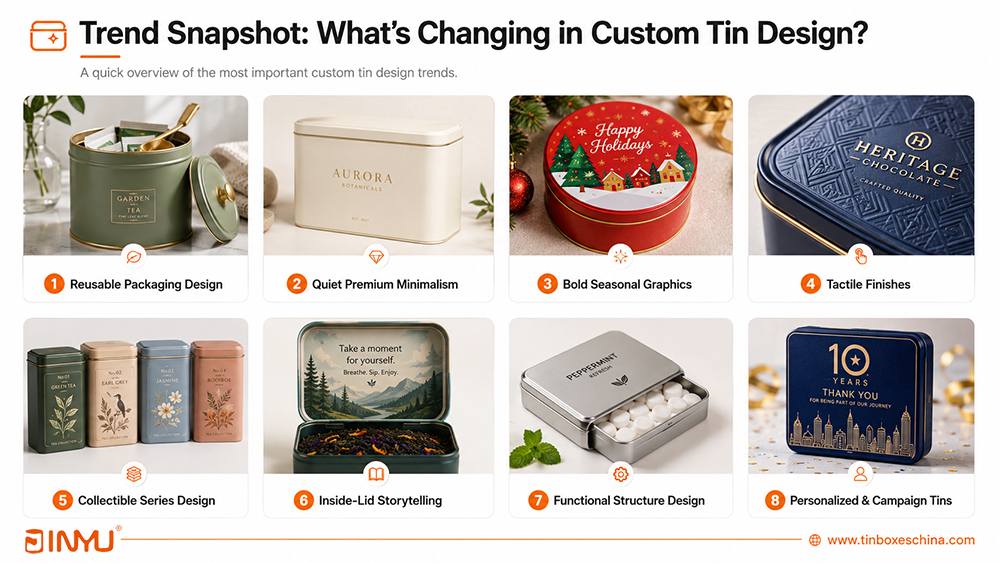
These trends do not have to be used all at once. In fact the best tin packaging tends to choose one clear design direction and do it well.
One of the biggest advantages of tin packaging is that it can be reused.
Many customers keep pretty tins for tea, cookies, sewing tools, stationery, jewellery, candy, coins, craft items, or other small personal things. This gives the packaging a second life and increases brand visibility beyond the first purchase.
This alters the design goal for brands.
The tin should not appear to be something that is supposed to be thrown away straight away. It should feel like it’s worth going on.
Tin packaging can be reused:
Reusable tin design is especially good for:
If the logo is too large or the design looks too much like advertising, customers may be less likely to keep the tin. Good reusable tins should be decorative without being unrecognisable.
Not all premium tin cans need to be heavily decorated.
We’re seeing more and more brands embracing cleaner design systems: simple typography, restricted colour palettes, matte finishes, subtle embossing, generous spacing.
The trend is especially suitable for products that aim to convey quality, calm, craftsmanship or modern luxury.
Quiet premium tin design can include:
This trend is complemented by:
A tin can feel more expensive and confident with a minimal design. The brand doesn't have to yell. It allows the material, proportion and finish to do the talking.
Minimal design doesn't mean empty design. If the typography, spacing, surface finish or colour quality is poor, the tin may appear unfinished instead of premium.
Bold colour still packs a punch for retail packaging, while minimalism works for premium and lifestyle products.
Candy, cookie and snack tins, children’s gifts, seasonal products are often “must see now”. When it comes to these categories, bright colours can help convey flavour, fun, energy and occasion.
Can Use Bold Tin Design:
Bold colour is good for:
Colour can help customers quickly identify variants for product lines that come in multiple flavours.
Example:
Bright colours should still be kept in control. Too many colours, icons and typefaces can make the tin look cheap or confusing.
Physical tin packaging “You can feel it in your hands.”
And that’s why surface finish matters.
A matte tin is not the same as a glossy tin. An embossed logo is a different feel than a flat printed logo. A spot UV pattern can create contrast when the light strikes the surface. Metallic ink printing can enhance the perceived value of a seasonal or gift tin.
Common finishing options are:
Tactile finishes are good for:
| Brand Position | Suitable Finish Direction |
| Luxury | Matte finish, embossing, metallic details |
| Festive | Glossy finish, gold accents, bright colors |
| Natural | Soft matte, earthy colors, minimal varnish |
| Vintage | Distressed finish, retro artwork, warm tones |
| Promotional | Simple printing, logo focus, cost-efficient finish |
| Collectible | Embossing, limited artwork, special texture |
Finishing effects should enhance the design not overpower it. If you use embossing, hot stamping, metallic printing, spot UV and heavy illustration all in one design, it can make the tin look crowded and increase cost.
Tin Packaging Trends are Industry Specific
A tea tin shouldn't look like a candy tin. A cosmetic tin ought not to resemble a cookie tin. If that is not the brand message, a promotional tin should not look like a luxury chocolate tin.
There is a visual logic for each category.
Food tins have to say appetite, freshness, flavour, trust. Cookie tins can be in warm colours, with illustrations of ingredients, celebratory scenes, or nostalgic patterns. Botanical graphics, origin stories or calm premium colours can be used to decorate tea tins. Candy tins tend to have more cheerful and fun designs.
Gift tins should feel giftable. They often feature decorative artwork, ribbons, metallic effects, seasonal colours and reusable designs. The tin itself should be part of the gift.
Cosmetic tins need to feel clean, portable and trustworthy. They favour minimal graphics, soft colours, matte finishes and a clean product identity.
Promotional tins need to show the brand and control costs. The design should be focused on the place of placement of the logo, the message of the campaign, the practical size and the repeat-use value.
Candle tins are often designed with mood in mind: calming colours, scent cues, textured designs and decorative finishes. The tin should match the smell and the surroundings.
The outside of the tin is attractive.
The opening experience is created by the inside of the tin.
A growing number of brands are tapping the inside of the tin as a secondary design surface.
This simple detail can make the packaging for chocolates, cookies, tea samplers, gift sets and corporate tins feel more thoughtful.
It may also include:
Prepare the internal presentation well in advance. If inserts, cards or pouches are included after the tin size is confirmed, the internal space may not be sufficient.
Tin packaging is a natural choice for collectible design due to its durability and reusability.
Tins are used by many brands for seasonal series, flavour series, city series, holiday series, anniversary editions or artist collaboration packaging.
Tin packaging for collectibles can use:
Collectible series are especially effective for:
The collectible tin provides consumers with a reason to retain the packaging and possibly purchase more than one design.
It also creates a more cohesive visual system across product lines for the brands.
After all, a series should feel connected. Each tin may seem totally unrelated, and the collection may not even be a brand.
Tins in a custom shape can be very effective.
Heart-shaped can, book-shaped can, car-shaped can, house-shaped can, egg-shaped can and character-shaped can can attract attention immediately. They are especially useful for gifts, holidays, children’s products, promotional campaigns and limited editions.
But structure is not decoration.
A custom shape might look good, but if it takes up too much carton space or makes the product hard to pack, it might not be practical.
When are custom shapes most useful?
New brands often have safer existing moulds. Custom moulds can offer more differentiation for established product lines or high-volume seasonal launches.
Tinplate is recyclable and tin packaging is often reused by the consumer. But modern sustainable packaging design should be more than just “eco-friendly.”
A better way is to make the tin with a longer life.
Sustainable design should not compromise product protection. For example, swapping a plastic tray for a paper divider might seem like a more sustainable option, but it still needs to protect the product in transit.
A good sustainable design balances material responsibility, product protection and consumer reuse.
Promotional packaging is usually short term, but tin packaging has long term value.
A plastic giveaway can be discarded quickly. A useful tin can sit on a desk, shelf, kitchen counter or in a drawer for months or years.
tin design ideas to promote
Think about promotional tins for brands:
Promotional tins should not be over designed. The goal is usually visibility, practicality and cost control.
Not every trend works for every brand.
Brands should ask themselves before settling on design directions:
A trend is only good if it supports the product and the business objective. Design trends should always be checked against product requirements, tin structure, mold availability, inner packaging, MOQ, lead time, and production feasibility. If you are still defining the practical side of your project, read our related guide on:
| Product Goal | Better Tin Design Direction |
| Build premium perception | Matte finish, embossing, dark colors, clean typography |
| Increase retail shelf visibility | Bold color, strong artwork, glossy finish |
| Create gift value | Decorative artwork, metallic details, reusable structure |
| Support sustainability message | Reusable design, recyclable material, long-life artwork |
| Launch seasonal campaign | Limited artwork, festive colors, custom shapes |
| Reduce cost | Existing mold, simple printing, standard finish |
| Improve unboxing | Inside-lid printing, trays, dividers, message cards |
| Build collectible value | Series design, numbered editions, reusable tins |
This matrix keeps design decisions from purely being aesthetic. The best trend is a trend that solves a specific packaging goal.
Design of custom tin packaging is moving towards packaging that is not only attractive but useful, reusable, category-specific and emotionally memorable.
The tin should protect the product and communicate flavour for food brands.
It should feel like it’s ready to give and is worth keeping for gift brands.”
For cosmetic brands, it should feel clean, portable and premium.
Promotional products should keep the brand visible long after the campaign ends.
The best tin packaging design doesn’t have to follow every trend. It selects the right trend for the product, brand, customer and sales channel.
A good custom tin should look great on the shelf, work great in production, protect the product, support the brand message, and give the customer a reason to keep it.
These elements combine to make tin packaging much more than just a container. It becomes a part of the value of the product.
Trends include reusable tin design, quiet premium minimalism, bold seasonal graphics, tactile finishes, collectible series, inside-lid printing, sustainable design and functional custom structures.
Custom tins are popular for tea, coffee, cookies, chocolates, candies, cosmetics, candles, gifts, promotional products, stationery and speciality retail items.
No always. Minimalist designs work great for premium, natural, cosmetic and lifestyle products. Colourful designs often work better for candy, snacks, seasonal gifts and retail products that need shelf impact.
Some of the popular premium finishes include matte varnish, metallic printing, hot stamping effect, embossing, debossing, spot UV, pearlescent finishes, and textured varnishes.
Yes. Tin packaging can be used as reusable storage, keepsake packaging, collectible series or home-use decorative containers.
If you have a high-volume product, limited edition, seasonal campaign or signature brand packaging, custom-shaped tins are worth a look. Existing moulds are typically more practical for new brands or small orders.
Brands can look at reusable structures, recyclable materials, durable artwork, fewer unnecessary inserts, paper-based dividers where appropriate and clear recycling or reuse communication.
Brands need to consider product type, sales channel, target customer, budget, mould availability, MOQ, lead time, protection needs, and if the tin will be reused or collected.
Get The Latest Information And Special Offers


 IPv6 network supported
 English
 Français
 Deutsch
 Español
 Português