
Two custom rolling trays may look alike in a product photo but have very different wholesale prices.
The quotation could be for thin tinplate, a standard mould, one simple artwork, basic printing and bulk packing. Another might be thicker material, multiple designs, Pantone colours, metallic effects, a magnetic lid, individual retail boxes and stronger export protection.
We should not compare the unit price without considering the full specification, as this is misleading.
This guide explains the factors affecting the wholesale price of custom rolling trays, including MOQ, tray size, tinplate thickness, number of artworks, printing methods, surface finishes, molds, packaging, and shipping efficiency.
It is written for brands, smoke shops, distributors, promotional product companies and private label buyers that want to understand how a quotation is built before placing a bulk order.
Custom rolling trays are made to project specifications and are not sold as a set product.
Even if two trays are made with the same general rectangular shape, they could have different dimensions, thickness of the material, depth of forming, artwork coverage, varnish, printing layers, packaging and order quantity.
Thus the final price is a total production programme.
A useful quote should say what is included, not just give a single figure. The buyer needs to know if the price is for printing one or both sides, if it is based on an existing mold, how many designs are included and how the trays will be packed.
Sometimes the least starting price is not the least final price.
MOQ means minimum order quantity, but it also shows how the costs of production are allocated in custom manufacturing.
Before mass production can start, the factory has to have artwork, printing plates, ink, materials, cutting plans, forming equipment, quality inspection and packaging in place. These setup costs are the same for an order of 500 trays as for an order of 1,000 trays.
More units means spreading the fixed costs over more units. That is why the unit price normally decreases with the increase of the order size.
The MOQ is 1,000 pieces and up. The final MOQ depends on the size of the tray, the mold, the number of artworks, the printing process, the surface finish and the packaging requirements.
It’s easier to arrange one simple standard tray with one design than a project with multiple sizes and lots of artwork. Therefore, the MOQ should be taken together with the full specification.
A frequent misunderstanding about quotations refers to the quantity of artwork.
1,000 trays of a design is not the same job to produce as 1,000 trays spread over ten designs.
Each additional artwork may require prepress preparation, color checking, printing arrangement, sorting, identification, inspection and packing.
For example a buyer might order 1,000 trays in five designs, 200 pieces per design. While the total quantity is above the MOQ, each individual piece of artwork creates its own production load.
The factory must determine whether the designs can be efficiently placed on the same print sheet or if they will require separate print setups.
When requesting a quotation, buyers are advised to always include total order quantity and quantity required for each design.
The exact price break will depend on the project, but the general relationship is the same.
| Order situation | Effect on unit price | Main reason |
| Low total quantity, one design | Relatively high | Setup and printing costs are divided across fewer trays |
| Higher quantity, one design | Lower | Production setup becomes more efficient |
| High total quantity, many designs | May remain higher than expected | Each design adds preparation, sorting and inspection work |
| Repeat order with unchanged specification | Often more efficient | Artwork, structure and production details are already confirmed |
| Mixed sizes and structures | More complex quotation | Each size or structure may require separate molds, printing plans and cartons |
The lowest possible unit cost isn't always a result of a bigger order when it's broken down into too many sizes, artwork or packaging formats.
It relies on the order structure and not only on the final quantity. The efficiency of production is...
The larger trays require more tinplate, but the cost differential is not just a question of material consumption.
A larger rolling tray also means more print area, larger blanks, larger molds, more carton space and perhaps stronger packaging. It may reduce the number of trays that fit in a carton and add to shipping volume.
Small rolling trays tend to be less expensive to manufacture and ship. The medium tray gives the best mix of visual appeal, practicality and packing efficiency. Large trays have more shelf presence, but usually require higher material and freight budgets.
The dimensions should be suitable for the retail position.
Selecting the least expensive tray only to save price may limit artwork impact and customer experience. Choosing the largest tray without a clear commercial reason may increase cost without generating sufficient additional value.
Custom metal rolling trays are generally made from 0.28mm, 0.32mm or 0.35mm tinplate.
Although a difference of 0.02 mm or 0.03 mm may be small, it influences rigidity, weight, forming performance and product feel.
It is often used for cost-sensitive, promotional or high volume programs. Lightweight and economical, but tray size and forming structure should be able to give enough support.
It provides a practical trade-off between stiffness and cost. It is suitable for many common wholesale and private label projects.
This makes it feel more substantial and gives it more shelf presence. It is often selected for gift sets, larger trays and premium products and models with a magnetic lid.
Price alone cannot choose the right thickness.
A small tray could be fine in a lighter specification, whereas a large shallow tray might need heavier material or a more robust mold structure. Corner radius, rolled edges, forming depth, and tray proportions influence stiffness.
The cheapest material does not always make the best retail product.
The most economical way to start a custom rolling tray project is most often by using an existing mold.
The existing mold has been tested in dimension, edge forming, stacking, corner shape and production stability. This saves development time and eliminates the need to purchase new tooling.
And it also makes repeat orders and sampling easier.
If the buyer requires a custom shape, custom dimensions, custom compartments, a different edge height or a patented lid structure, a new mold may be required.
But new tools bring new costs, new time. It may also take a few rounds of structural adjustment before the product is ready for mass production.
For many new brands a stock mold with original artwork is enough differentiation. A slightly odd dimension doesn't always warrant the cost of custom tooling.
A tray that has printing only on the main inside surface is less expensive than a tray that is fully printed on the inside, sides, back and magnetic lid.
The printing coverage affects the material preparation, sheet layout, colour management, coating and inspection.
A buyer shall indicate whether printing is required on:
The main tray surface, surrounding edges, outer back, exterior of the magnetic lid, interior of the lid, or any visible surfaces.
Back printing is generally used for logos, websites, product information, barcodes or legal text. It adds value but also creates another need for production.
“The quote should state which surfaces are included.
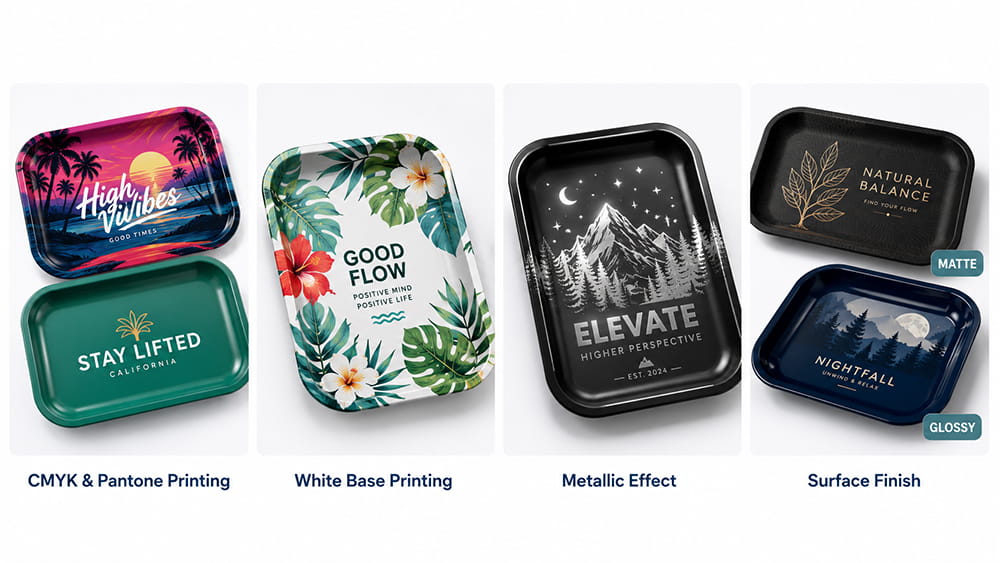
CMYK printing is a great choice for detailed illustrations, gradients, photographic art and multi-color designs. It is widely used because a single printing system can reproduce a wide range of visual content.
Pantone spot colors are good when a buyer needs more consistency for a corporate color, logo, or large solid area.
A simple CMYK project is often easier to arrange than a design that needs CMYK plus multiple Pantone colors.
Additional spot colors may require a separate ink preparation, printing control and color approval.
The price difference is not simply about the ink. It also reflects additional setup and inspection required to reproduce the desired brand color.
Therefore, buyers should decide which colors are really important. You don’t have to change all the shades in the artwork to a separate Pantone color.
Tinplate is naturally shiny silver in color.
The silver reflection can show through the colored ink directly printed over the metal, altering the appearance of the artwork. A white undercoat reduces this effect and allows colors to be brighter and more solid.
The most common type of white base printing is for artwork in pastel colors, clean backgrounds, detailed graphics, accurate brand colors and photographic designs.
The extra coating layer will affect the manufacturing process and could affect the quote.
However, in some cases, the white base is removed for financial reasons, which can lead to the final colors being darker or more metallic, or not matching the original design.
The choice should be based on the visual effect you want.
Metallic effects are achieved by using the natural reflection of the tinplate in the design.
In some areas, we may leave out the full white base and let the silver highlights show through the clear inks. This enables the creation of metallic logos, borders, vintage textures or reflective decorative objects.
The visual result can be strong, but the artwork has to be prepared well.
The factory needs a clear differentiation between the white-base areas, metallic areas, normal CMYK artwork and any Pantone colours.
If files are not well prepared it may take additional time to adjust the design and get approval.
Metallic printing is not a filter that you add in the factory. It must be planned in the preparation of artwork.
Matte and glossy varnishes may not be the biggest difference in price, but they do have a big impact on how the product is seen.
A shiny tray typically appears brighter, more energetic and more reflective. A matte finish delivers a more subdued, controlled look and is often found in premium or minimalist collections.
Special finishes add more steps in production.
Embossing, debossing, spot gloss, glow-in-the-dark ink, raised 3D effects, decorative edge printing … and the list goes on. Some require more tools, more levels of print or a more careful alignment.
The effect should confirm the product idea.
Multiple special finishes on one tray can add cost without adding customer appeal. One well chosen effect is often better than a combination of all the options you can get your hands on.
The most simple structure is a standard open rolling tray.
A magnetic lid rolling tray requires an additional printed metal part, magnets, assembly, alignment and additional protective packaging.
The lid may also be printed on one or two sides. When the inner tray and lid are designed with coordinated artwork, the project requires additional design and quality control work.
A magnetic lid tray will usually cost more than an open tray of the same size.
But the lid can also contribute to the perceived value.
It provides more room for artwork, enhances portability, safeguards the inside surface, and makes the product more gift-worthy and premium retail friendly.
The question is not simply whether the lid increases cost. The buyer should inquire if it allows for a higher retail price and a better customer experience.
“Packaging comes in too late in the project.
The same metal structure can be used for a bulk-packed tray and for a retail product in individual boxes, but the total prices can be very different.
Basic bulk packing is cost effective and suitable for distributors who will be re-packing the products locally. Individual polybags provide better protection against dust and light scratches.
Paper sleeves allow for branding, collection names, barcodes and product information without covering the whole tray.
Better protection of the individual cartons and a more complete retail presentation. Boxes with foam, paperboard, PET or molded inserts cost more but they can hold a higher product position.
Packaging also affects carton size, labor, storage volume and shipping volume.
A nice tray in a crappy unbranded bag could reduce perceived value. However, an expensive gift box may not be required for an entry level promotional product.
Packaging should be appropriate for the sales channel and target retail price.
The product is shown to the customer on the retail packaging. The whole order is protected by export packing during transport.
Metal trays can scratch when they are stacked directly against each other. Large trays can also warp under the weight of overloaded or poorly supported cartons.
Export packing can include tissue, protective sheets, individual bags, dividers, inner cartons, reinforced master cartons, corner protection and pallets.
More expensive packing is stronger, but inadequate packing can lead to a much larger loss through scratches, dents and customer claims.
The quotation should indicate the protection of the trays in long haul shipping.
No visible packaging charges doesn't mean the quotation is cheaper It may be that the level of protection is lower
It’s much easier to get a clean vector file than a low-res screenshot or a flattened image.
The factory can more easily adjust the bleed, safe zones, color separations, metallic layers and emboss locations if the artwork is in editable AI, PDF, EPS, CDR or proper PSD format.
Low resolution files may need to be reconstructed. Production delays can also be caused by missing fonts, unembedded images, unclear brand colors, and incomplete dielines.
Some factories also include basic layout adjustment in the project. Additional fees or a longer approval time might be needed for more complex design reconstruction.
Early prepared correct artwork saves cost and delay.
A digital mockup is good for reviewing layout and general design direction, but it can't fully capture printed metal.
Screening is not a good substitute for the real thing with metal reflection, white base, varnish, embossing, edge forming and color under different lighting conditions.
A simple sample of the structure can check dimensions, edge quality, forming depth, stacking and lid fit.
If the project includes important Pantone colors, metallic effects, embossing, specialty coating or premium retail positioning, a printed sample is more valuable.
Sampling adds a cost upfront but can save a lot of money down the road in mass production .
The standard sampling time at Rollvane is normally 7-10 days after structure, artwork and finishing details are confirmed. Mass production usually takes about 25 to 35 days, depending on the size and complexity of the project.
For very detailed projects, one sample round isn’t always enough.
If after the first sample the buyer alters the artwork, color, tray size, finish or packaging, additional sampling may be required.
Small text modifications are possible in digital form. Major changes in colour or structure generally require a new physical sample.
Changes late in the development process increase cost and time to market.
The best way to control this is to confirm the tray mold, artwork direction, colors, finish and packaging before you request the printed sample.
A clear internal approval process also prevents different team members from making changes to the project once production prep has begun.
The trays are light but if you have a lot they can take up a lot of space.
Factors affecting freight include gross weight, carton size, destination, method of shipping, use of pallets, and efficiency of tray nesting.
Small and medium open trays usually stack well. Magnetic lids, individual boxes and gift sets take up more room and could reduce the number of units per carton.
For example, if a product has a packing method that leads to inefficient shipping volume, a slightly lower factory price might lead to a higher landed cost.
Buyers should therefore request information on carton size, quantity per carton, gross weight and total shipment volume.
The most useful comparison is the total landed cost – not the ex-factory unit price.
Different suppliers may quote for different services;
One price includes artwork adjustment, sampling support, full surface printing, individual bags, stronger carton, export documentation.
Another only bulk packs the basic tray.
Before comparing quotations, buyers should check whether the quotation includes the following items: material specification, mold use, printing coverage, surface varnish, special finishes, magnetic components, individual packaging, export cartons, sampling, quality inspection, shipping terms.
The quote should also state whether or not it excludes taxes, tooling, sample freight and overseas shipping costs.
Two similar unit prices can be very different levels of product and service.
| Cost factor | Lower-cost direction | Higher-cost direction |
| Order quantity | Larger quantity with one design | Small quantity or many low-volume designs |
| Tray size | Small or standard medium size | Large or non-standard size |
| Tinplate thickness | 0.32mm | 0.35mm |
| Mold | Existing standard mold | New custom tooling |
| Printing | Standard CMYK, one main surface | CMYK plus Pantone, back printing or multiple surfaces |
| Visual effect | Standard white base and varnish | Metallic separation, embossing, glow or 3D effects |
| Structure | Open tray | Magnetic lid or special structure |
| Packaging | Bulk packing or polybag | Sleeve, individual carton or gift box |
| Artwork count | One or two designs | Several designs in small quantities |
| Shipping efficiency | Nested trays in compact cartons | Large boxed products or complete gift sets |
The table illustrates why you cannot assess a quotation on a single specification.
More quantity can reduce unit cost but that benefit can be offset by multiple designs, special finishes or complex packaging.
A very low quote could be on thinner material, limited printing coverage, weak cartons or no individual protection.
These selections may be appropriate for some promotional programs. They are a problem when the buyer expects premium retail quality.
A tray that is easily bent, scratched, inaccurate in colour or inconsistent with the brand results in returns, complaints and lost repeat orders.
The cheapest price can also involve hidden costs if the buyer needs local repacking, replacement cartons, extra inspection or product reworking.
A better question might be:
Which specification provides the best compromise of landed cost, retail price and customer experience?
The cost cutting should start from the production efficiency instead of only removing the quality.
One of the most cost-effective ways to reduce development expense is to use an existing mold. The first launch will be restricted to a single main size and three or four coordinated designs to help with printing and inventory management.
One carefully applied finish can often be more cost effective than several decorative processes on a standard CMYK design.
Buyers can also reduce cost by using a paper sleeve instead of a full individual carton, a medium tray instead of an oversized structure and avoiding unnecessary printing on hidden surfaces.
Higher order quantities can help with pricing but only if the brand has enough demand to actually sell the inventory.
Over-ordering just to get a lower unit price can create slow-moving stock and higher storage cost.
The best cost savings plan keeps the features that customers notice and simplifies the details that do not affect the buying decision.
The phrase “custom rolling tray” alone doesn’t give a supplier a good price.
When requesting a quotation, please indicate tray size, preferred tinplate thickness, open or magnetic lid structure, total quantity, quantity per design, printing method, finish, packaging, destination country and required delivery time.
Artwork files or visual references are also helpful.
Even if the final design is not set, the supplier needs to know if the project is using simple logo printing, full color illustration, metallic effects, embossing or coordinated lid artwork.
By giving all information from the start you will avoid follow up questions and will be able to compare suppliers in a more accurate way.
A common mistake is to compare trays of different thicknesses as though they were the same products.
Another is asking for a total quantity but not saying how many artworks will be included. Buyers may forget to verify whether the quotation includes magnetic lids or back printing or individual packaging or export cartons.
Choosing special finishes before setting the target retail price can also create unnecessary cost.
Some buyers only focus on the factory price, ignoring the freight volume. Others place a big first order for a lower unit cost without testing what designs will sell.
A good price is based on the entire project, not just one figure in the quotation.
Our tandard MOQ begins from 1,000 pieces. Final MOQ depends on tray size, structure, number of designs, printing process, finish and packaging.
Usually, but not invariably. The more you make the more efficient it is but too many designs, mixed sizes, special finishes and complex packaging can kill the efficiency.
The big trays use more material and more space in the carton. They might also step up the amount of freight. The difference depends on thickness, printing and packaging.
Sure. More material means more material costs and a more substantial feel to the product. Often it's for premium or bigger products.
Standard CMYK is usually more efficient for multi-color artwork. Pantone colors can add to setup and ink costs, particularly when several spot colors are required.
Yeah. Embossing generally requires additional tooling, alignment and production control.
Yes. They need additional lid, magnets, printing, assembly, inspection and more protective packing.
It could be, but the quote will depend on how much per design, and if the artworks can be laid out in a production friendly way.
Sometimes no. Buyers should verify whether the price is for bulk packing, polybags, paper sleeves, individual cartons or gift boxes.
It normally takes 7 to 10 days to sample. Mass production normally takes 25-35 days after sample and artwork approval.
The cost of wholesale custom rolling trays depends upon a series of related decisions.
MOQ influences the production efficiency. Material use and product feel are affected by size and thickness. Number of art pieces influences printing and sorting. Surface finishes affect both cost and retail positioning. Packaging and shipping are crucial to getting the finished product there safely and staying competitive in the market.
A good quotation should highlight these differences.
Wholesale buyers do not need the most expensive spec for every project but they do need a spec that fits the intended customer, retail price and sales channel.
Selecting the lowest number does not always mean the best value.
It comes from knowing which features add value to the product, which details add to the cost of production and where the specification can be simplified without compromising the final tray.

Get The Latest Information And Special Offers


 IPv6 network supported
 English
 Français
 Deutsch
 Español
 Português