
By the end of Q4 2025, the tone of incoming inquiries quietly changed.Buyers who had sourced metal packaging from China for years stopped opening with price. Instead, the first message often looked like this:
“Are you the actual factory, or a trading company?”
This shift didn’t come from market theory. It came from missed retail windows.In one case, a European Christmas biscuit project lost its shelf slot because final samples arrived three weeks late — not due to production failure, but because tooling revisions had to pass through multiple hands.
When timelines tighten, the difference between a real tin box factory and a trading company stops being abstract. It becomes operational.
Tooling is rarely discussed in early quotations, yet it’s often where schedules break.
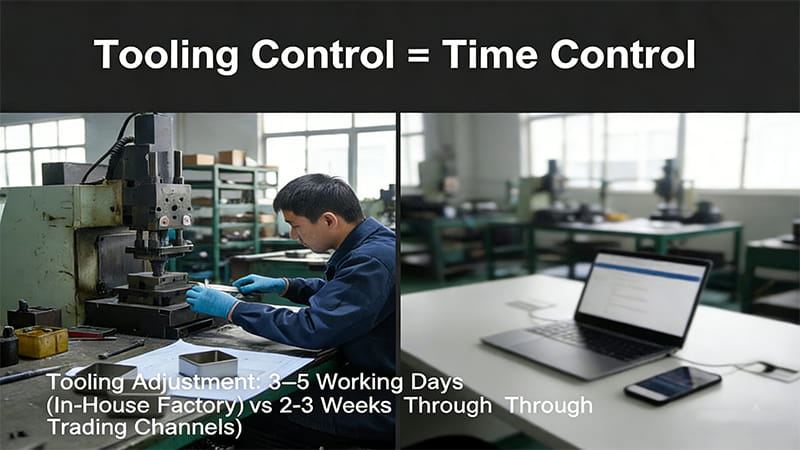
In a real tin box factory, tooling is either owned or managed in-house. Based on our day-to-day production experience:
When sourcing through a trading company, the same request often requires:
In practice, that process commonly stretches to 2–3 weeks.
This gap is invisible at the quotation stage, but it becomes very real once a project moves beyond standard sizes.
On paper, many suppliers quote similar lead times — 25 days, 30 days, sometimes less.
The difference is not speed, but control.
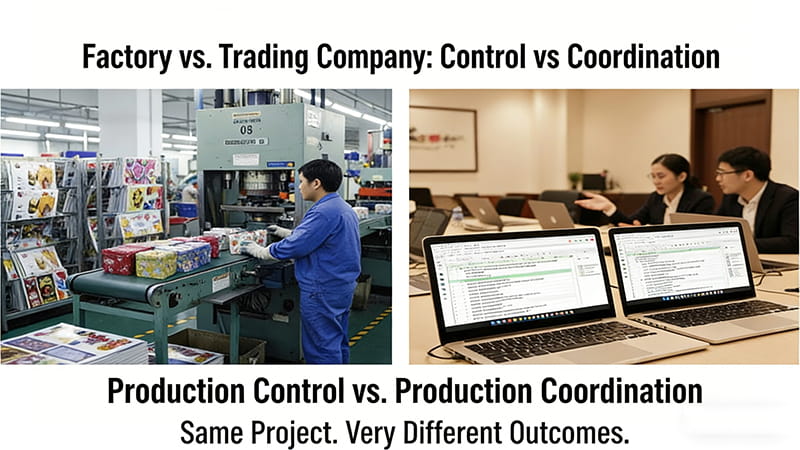
A china custom tin box factory manages printing, stamping, and assembly as one production flow. If printing finishes early, downstream steps can move forward immediately.
With trading companies, each step may happen at a different facility. A one-day delay in printing doesn’t pause the clock — it cascades.
This is why buyers sometimes feel their project is “always almost done,” yet never quite shipping.
Many suppliers advertise OEM / ODM services. Fewer explain what that means once production starts.
In a factory environment:
For projects involving custom hinges, window tins, or non-standard depths, working directly with an OEM ODM tin box factory allows problems to surface during sampling — not after mass production.
That distinction matters most when timelines are tight and revisions are unavoidable.
There’s a consistent pattern we see across projects:
Factories monitor stamping pressure, print alignment, and assembly tolerances internally. Problems are flagged before volume begins.
Trading companies often rely on final inspection reports. By then, thousands of units may already be complete.
For food tins, gift packaging, and seasonal products, discovering issues late is rarely a small problem — it’s usually a commercial one.
Initial quotations from trading companies can look competitive. Margins are compressed to win the order.
Differences emerge on repeat projects:
A long-term relationship with a tin box manufacturer tends to reduce these surprises, because production decisions remain consistent from one order to the next.
Stability, not price, is what usually determines total project cost over time.
As we move through 2025, sourcing conversations are becoming more direct.
Buyers increasingly ask for:
The direction is clear. Sourcing decisions are shifting away from who can quote fastest toward who controls the process from start to finish.
If you’re planning a seasonal launch or a complex custom tin project where timing and consistency matter, the factory question is no longer optional — it’s foundational.
If you are preparing for a 2025 seasonal program or a custom tin box project and want full visibility from tooling to final shipment, we invite you to start a different kind of conversation.
Feel free to contact us and request a real factory video walkthrough to see how production is actually handled.
Get The Latest Information And Special Offers


 IPv6 network supported
 English
 Français
 Deutsch
 Español
 Português