
A buyer may ask for a tin that holds 200 grams of cookies. Another may request packaging for 12 biscuits. Both sound like clear specifications, but neither tells a tin manufacturer enough to choose the right size.
Two products with the same net weight can require very different containers. Twelve thin butter cookies take up far less space than twelve thick oatmeal cookies. Individually wrapped biscuits need more room than loose biscuits. A fitted tray can improve presentation but reduce usable capacity. Even the shape of the cookie changes how efficiently it fits.
That is why cookie tin capacity should be calculated from the product outward. Start with the baked cookie, decide how it will be arranged and protected, and then match the pack-out to a suitable tin.
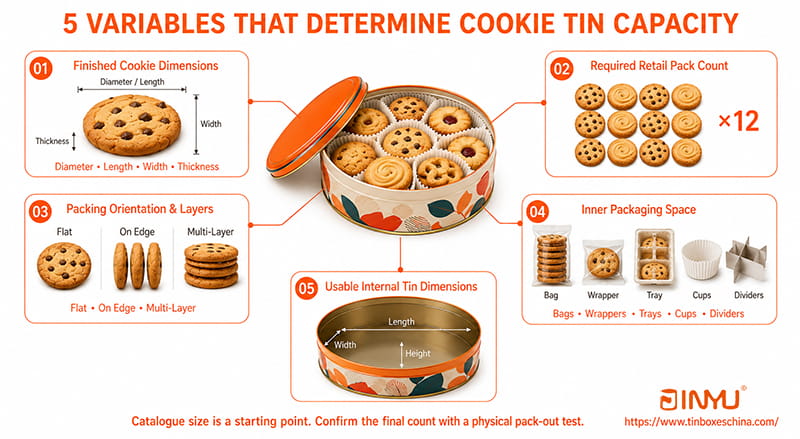
Cookie dough is not the correct measurement reference. Butter content, dough temperature, resting time and oven conditions can all affect spreading. Cookie spread is not a random change. A study of sugar-snap cookies tracked the spread rate, setting time and structural collapse during baking, finding that formulation changes could alter the final diameter, height and break strength of the cookie. For packaging teams, the practical lesson is straightforward: measure the finished cookie after baking and cooling, rather than relying on the cutter or raw dough size.
Measure cookies after they have been baked and cooled completely. For each product, record the widest diameter or longest point, overall thickness and normal size variation across a batch.
Measuring only one perfect cookie is risky. Commercial baked products are rarely identical. If most cookies measure 62 mm but some reach 66 mm, designing the compartment around 62 mm may cause problems during packing.
A sensible measurement exercise uses at least 10–20 cookies from a representative production batch. Record the average size, but design around a practical upper limit rather than the smallest sample.
| Measurement to confirm | Why it affects tin capacity | Common mistake |
| Maximum diameter or length | Determines the number of cookies that fit across each row | Measuring the dough cutter instead of the baked product |
| Maximum width | Important for rectangular, finger-shaped and irregular cookies | Assuming every cookie is perfectly round |
| Average and maximum thickness | Controls the number of layers that fit under the lid | Measuring only the thinnest sample |
| Batch variation | Allows for normal production differences | Designing the tray around one ideal cookie |
| Decoration height | Icing, drizzle or toppings may need additional clearance | Allowing decorations to touch the next layer |
| Wrapped dimensions | Flow wrap and folded seals increase the footprint | Measuring the unwrapped cookie only |
A 300-gram fill weight is useful for labelling and retail planning, but it does not define the necessary tin dimensions.
Consider three products:
All three packs could weigh 300 grams while requiring different tin volumes. Weight and physical footprint do not always change together. In one biscuit formulation study, adjusting the flour composition significantly changed width, thickness, weight, hardness and brittleness. This helps explain why two 300 grams cookie assortments can occupy very different amounts of space once they are arranged inside a tin.
Weight becomes useful only after the brand knows the average weight per cookie and the intended number of pieces. Even then, the physical arrangement must still be tested.
The better starting specification is:
"20 cookies, approximately 60 mm in diameter and 10 mm thick, packed in four layers with paper separators."
That gives the packaging supplier something that can actually be laid out.
Product catalogues normally show the nominal or external size of a tin. The space available to the cookies will be smaller.
Usable internal space can be reduced by:
For retail data and carton planning, package dimensions should also be recorded consistently. GS1 provides a standardised method for measuring product packages, but those external trade-item measurements should not be confused with the internal space available for filling.
Before calculating capacity, ask the supplier for the usable internal length, width and height of the proposed tin—not only its catalogue dimensions.
For round cookies placed in a straight grid inside a rectangular tin, a starting estimate can be calculated as follows:
Cookies per row = floor((usable internal length + selected gap) ÷ (cookie diameter + selected gap))
Rows per layer = floor((usable internal width + selected gap) ÷ (cookie diameter + selected gap))
Number of layers = floor((usable internal height + separator thickness) ÷ (cookie thickness + separator thickness))
Estimated capacity = cookies per row × rows per layer × number of layers
“Floor” means rounding down to the nearest whole number.
The selected gap is not a universal number. A robust, individually wrapped biscuit may tolerate a closer arrangement. A decorated or fragile cookie may require more clearance or an individual compartment. The correct allowance should be confirmed during sampling.
Suppose a rectangular tin provides usable internal dimensions of:
The cookies are approximately:
The initial layout uses:
The preliminary calculation gives:
Cookies per row: floor((214 + 3) ÷ (60 + 3)) = 3
Rows per layer: floor((154 + 3) ÷ (60 + 3)) = 2
Layers: floor((48 + 2) ÷ (10 + 2)) = 4
Preliminary capacity: 3 × 2 × 4 = 24 cookies
This does not mean the tin is automatically approved for 24 cookies. The layout still needs to be checked for cookie variation, separator compression, lid clearance, filling speed and movement during transport.
The calculation narrows the options. The physical sample makes the final decision.
Round tins are strongly associated with Dutch and Danish butter cookies, but their capacity is less convenient to calculate using a simple row-and-column formula.
A square grid leaves unused areas around the curved wall. A staggered arrangement may fit more cookies, but it can also make automatic or manual loading less consistent. Assorted butter cookies create another complication because rings, rectangles and pretzel-shaped biscuits occupy the space differently. This is more than a packaging-floor inconvenience. In operations research, fitting unequal circles into round, square or rectangular containers is treated as an optimisation problem rather than a simple row-by-column calculation. That is why a capacity formula may provide a useful starting point, while a mixed assortment still needs a CAD layout or physical packing trial.
For example, Jinyu’s D220*H70 mm round Dutch and Danish cookie tin provides a familiar format for butter cookie assortments. However, its actual fill count still depends on:
For a uniform round cookie, CAD layout can produce a useful estimate. For a mixed assortment, manually arranging real products in a plain tin sample is usually faster and more reliable.
The inner packaging is not a detail to add after the tin has been selected. It can substantially change the required dimensions.
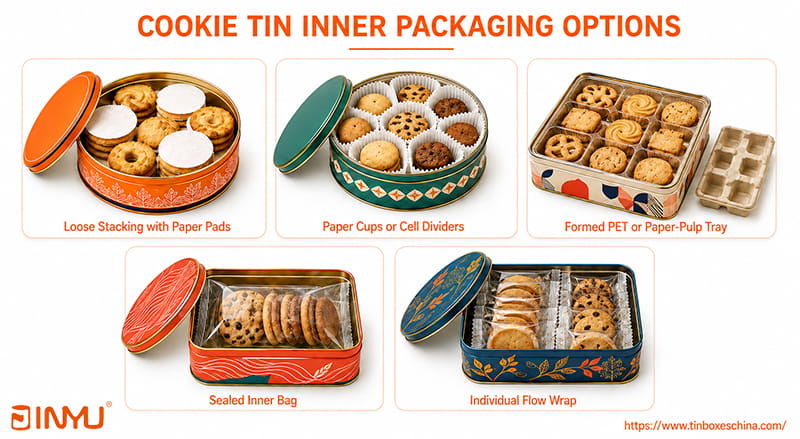
| Packing method | Capacity effect | Best suited to | Main point to verify |
| Loose stacking with paper pads | Usually provides the highest piece count | Strong butter cookies and traditional assortments | Rubbing, crumbs and movement |
| Paper cups or cell dividers | Reduces capacity moderately | Mixed flavours and visible gift arrangements | Compartment size and assembly time |
| Formed PET or paper-pulp tray | Reduces capacity but gives consistent positioning | Fragile or premium assortments | Tray wall thickness and usable cavity size |
| Sealed inner bag | Capacity depends on the bag and folded seals | Products requiring stronger moisture protection | Bag inflation, seal width and filling process |
| Individual flow wrap | Usually requires a larger tin | Export, hospitality and portion-controlled products | Wrapper seams and final wrapped dimensions |
A divider separates products but does not necessarily provide a moisture or aroma barrier. If crisp and soft cookies share one tin, separate sealed packs may be more dependable than an open divider alone. Similarly, parchment paper can protect surfaces and reduce sticking, but it should not be treated as the primary moisture barrier for a commercial shelf-life programme.
The inner pack is not only a space calculation. Researchers comparing multilayer biscuit packaging monitored changes in moisture, water activity, texture and oxidation during storage. The findings reinforce an important packaging principle: the bag or wrapper should be selected for product protection first, and only then included in the tin capacity calculation.
A single-layer arrangement uses more lid area but creates a stronger opening presentation. Every cookie is visible when the customer lifts the lid. This works well for decorated biscuits, premium selections and products sold mainly as gifts.
Stacked arrangements use the vertical space more efficiently. They are better suited to larger counts and family-size packs, but the lower layers need protection from pressure.
When comparing the two approaches, consider more than capacity:
A taller tin is not always better. Excess height can allow the biscuits to move vertically, and it may increase material and freight costs without improving the retail experience.
The same cookie may need different packaging depending on where it is sold.
A supermarket pack needs efficient shelf dimensions, a clear front-facing panel and consistent case packing.
A seasonal gift tin may prioritise lid artwork, assortment presentation and reusable value.
An e-commerce pack needs stronger control of movement and a secondary shipping carton that protects the tin from denting.
A corporate gift may need several flavours, a printed message, an insert and a presentation sleeve.
Before approving the tin size, check the complete route:
Cookie production → filling → case packing → pallet or parcel transport → retail display → customer opening
A size that works on the design screen may become awkward on the filling table or waste space in the export carton.
“500g cookie tin” is not a complete structural specification. Cookie dimensions, count and arrangement are still required.
Nominal tin dimensions include metal structure that the product cannot occupy. Request usable internal dimensions.
Production variation can cause an insert that worked during design approval to become too tight in mass packing.
Individual wrapping, gussets and folded seals can add several millimetres around each product.
A fitted insert may remove more internal space than expected, particularly around the walls and corners.
Excess space increases movement. Protection comes from correct fit and internal support, not empty volume.
A computer layout cannot fully show crumbs, surface friction, wrapper behaviour, hand-loading speed or the way cookies settle during transport.
Before mass production, prepare a plain tin or structural sample and pack it exactly as it will be packed commercially.
Use production-representative cookies, not wooden blocks or idealised 3D models. Include the final paper pads, cups, tray, inner bag and wrapping materials.
Then check:
A pack that performs well on the packing table is not automatically ready for distribution. Transport research shows that vibration intensity, shocks, test duration and multi-axis movement can vary considerably between delivery environments. An e-commerce cookie tin should therefore be tested inside its final shipping carton, while a supermarket pack should be evaluated in the case configuration used for pallet transport. Packaging performance should be reviewed again when the cookie size, count, materials, inner packaging or distribution method changes. ISTA similarly recommends retesting packaged products when changes to the product, package or process could affect distribution performance.
A useful capacity recommendation starts with useful product information. Prepare:
With these details, a manufacturer can compare the pack-out against existing moulds before recommending new tooling.
Jinyu offers a range of cookie and biscuit tin boxes, including round, square, rectangular and divided formats. The normal MOQ for custom printed production is 5,000 pieces. Sampling generally takes 7–10 days, followed by approximately 25–35 days for mass production after approval.
There is no single standard size for 12 cookies. Measure the baked diameter and thickness, decide whether the cookies will be placed in one layer or stacked, and include the space taken by liners or wrappers. Twelve 50 mm cookies require a very different tin from twelve 90 mm bakery-style cookies.
The answer depends on cookie diameter, thickness, assortment and inner packaging. A 220 mm round tin may hold several layers of small butter biscuits, but fewer large or individually wrapped cookies. Test the proposed layout with real products before confirming the printed packaging.
Only approximately. Net weight becomes useful after you know the average weight and dimensions of each cookie. Final tin selection should be based on physical arrangement, not weight alone.
Use the usable internal dimensions for capacity calculations. External dimensions are still needed for retail data, cartons and pallet planning, but they overstate the space available to the product.
Square and rectangular tins usually use shelf and carton space more efficiently. Whether they hold more cookies depends on the cookie shape and arrangement. Round cookies can still work well in round tins, especially when the traditional gift presentation is part of the product positioning.
There is no universal gap. The correct allowance depends on cookie variation, fragility, decoration, wrapping and transport conditions. Use enough clearance to prevent binding, then control movement with liners, cups, trays or dividers.
Usually not. Dividers take up internal space, but they can reduce movement, separate flavours and improve the opening presentation. A layered separator may allow safer vertical stacking, while a cell divider normally lowers the number of cookies per layer.
For most first projects, an existing mould is the more practical starting point. It reduces tooling investment and makes sample development faster. A new mould becomes worthwhile when the required pack-out cannot be achieved with available sizes or when the proprietary structure is central to the brand.
The following peer-reviewed studies support the baking, product protection, packing and transport principles discussed in this guide.
The most useful answer to “How many cookies fit in a tin?” rarely comes from a generic capacity chart.
Start with cooled production cookies. Measure the largest realistic dimensions. Decide on the count, layout and inner packaging. Calculate using usable internal space, then confirm everything with a physical pack-out.
That process may take a little longer than selecting a tin from a catalogue, but it prevents a much more expensive problem: receiving thousands of attractive printed tins that do not fit the product properly.

Get The Latest Information And Special Offers


 IPv6 network supported
 English
 Français
 Deutsch
 Español
 Português