
Only the inner seal of a matcha tin should be broken. It has to stay alive through filling, shipping, storage, then open cleanly when someone makes their first bowl of tea.
It’s quite a demanding brief for a small component. An awkwardly gripped pull tab, a membrane that tears halfway across or powder spread across the counter can destroy an otherwise carefully designed pack.
When comparing ring-pull and peel-off foil lids for matcha tins, start with the construction and filling process. Those decisions decide what options are available. Then the opening experience, and a question that deserves more thought: how will the customer close the tin tomorrow?
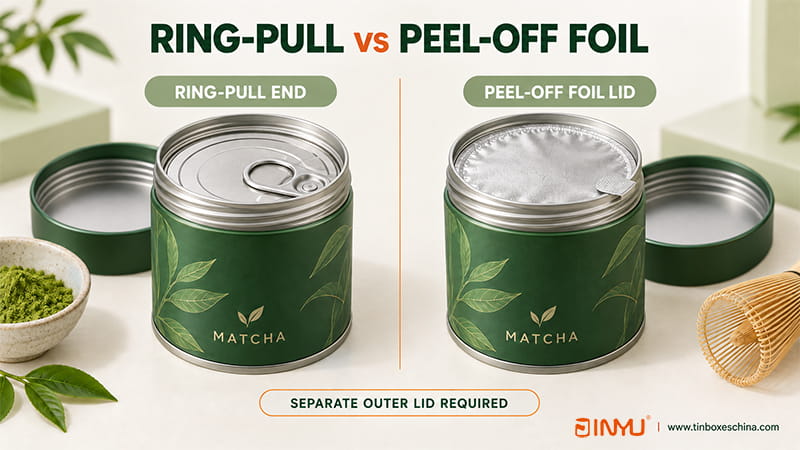
Choose the closure your filler can consistently use, then approve it on a filled tin with its intended outer lid. Unopened products can be protected by ring-pull ends or by appropriate peel-off foil systems. Neither reseals original seal after opening nor names shelf life by itself.
| What you’re comparing | Ring-pull end | Peel-off foil lid |
| Opening action | Lift a tab and tear a scored metal panel | Grip a tab and peel a flexible membrane |
| Attachment to the tin | Usually double-seamed to a compatible body | Sealed directly to a suitable rim, or supplied on a ring that is seamed to the body |
| Major component controls | Score, tab attachment and end dimensions | Membrane construction, bond and peel consistency |
| First-opening evidence | Permanent metal panel | Permanent membrane removed or damaged |
| Reclosure | Separate outer lid required | Separate outer lid required |
| Concerns | Tab damage, panel distortion and seam damage | Puncture, membrane damage and seal damage |
Matcha is a powder that is finely milled. To preserve its color, aroma and flavor it is necessary to control its exposure to air, moisture, light and heat during the life of the pack.
The body is metal and blocks light. The body joints, ends and seals limit the ingress of air and moisture. Filling conditions determine what's trapped inside at closing. The outer lid is there for the customer after the original seal is gone.
One detail changes the conversation: is the matcha filled directly into the tin, or sealed in a separate inner pouch? In a sealed pouch, that pouch is usually the first barrier. A can with loose powder directly inside has different requirements than a decorative tin around it.
Compare matcha tin sealing options after you’ve settled this.
A ring-pull lid comprises a rigid metal panel having a controlled score line and a tab attached thereto. Pulling and lifting the tab starts the opening and tears the panel along that path.
The end must be compatible with the can body and its seaming spec. When the panel is opened it is impossible to return the closure to its original condition. A second lid provides subsequent closure.
Request the end drawing and material specification. The pull ring is captured in a photo but the score design, tab attachment and joining details are mostly invisible.
The term "peel-off foil" can be used to describe a variety of constructions. A membrane can be bonded directly to a matching opening, and/or can arrive already bonded to a rigid ring that is then attached to the can.
The latter is exemplified by Crown's PeelSeam, where flexible foil is heat-sealed to a steel ring and the assembled end fitted by conventional double seaming. The construction illustrates why a foil opening does not need a heat-sealing station at the filler as a matter of course. Crown's PeelSeam construction.
Also check what “foil” means in the quote. Aluminum foil laminates and metallized plastic films are different materials Define the full membrane, sealing layer and the bonded surface to.
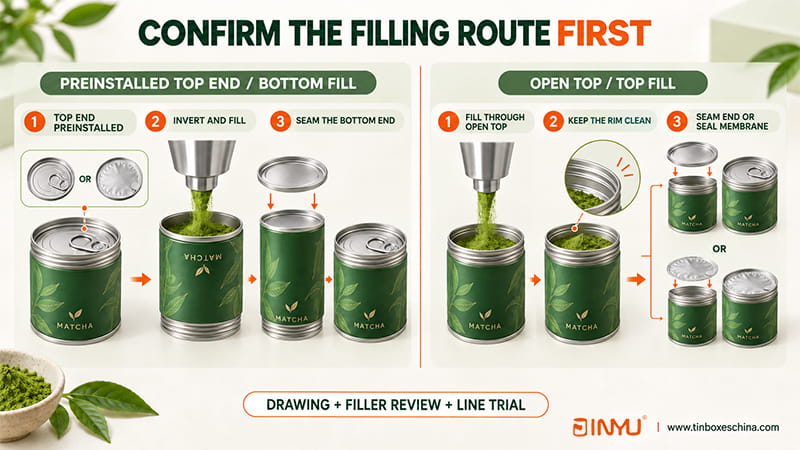
We suggest that the proposed can and end drawings be sent to the filling partner before committing to artwork or tooling.
Ask a direct question: “Under what condition will the empty tins arrive, and through which opening will you fill?”
A possible compatible production route is to fill the inverted can through its open bottom and then seam on the bottom end with a preinstalled top end. The consumer's ring-pull or foil opening is already there.
A top-filling route is different. Product enters through the top and then the filler fits and seams an end or seals a membrane to the specified rim. The equipment is dependent on the construction selected.
Nominal diameter is only a starting point. The filler must inspect the body flange, end profile, seaming tooling, handling clearances and, if applicable, heat-sealing conditions. Just because two parts are described as the same diameter does not mean they are interchangeable.
One thing to note in trials for direct heat sealing is the presence of matcha dust on the sealing surface. An empty sample will not show the behavior of the actual powder around the filling nozzle or whether the rim stays clean at production speed.
A useful comparison is that between two completed, filled packs made under defined conditions.
The oxygen transmission rate (OTR) or water vapor transmission rate (WVTR) of a material is representative of a given test specimen. It does not cover all the possible entry points into an assembled can. Body joints, double seams, sealing compounds, membrane bonds and damage all count.
Foil thickness alone is not enough. Industry guidance distinguishes pinholes confined to the foil layer from holes that go all the way through a laminate; these can have very different effects on barrier performance. Flexing and the sealing layer should also be taken into account. SPMC guidelines for foil laminate barriers.
For a meaningful comparison use the same matcha, fill weight, headspace, filling process and storage conditions. Check the integrity of the package and follow changes in color, smell, taste and moisture throughout the intended period of storage.
If the line is nitrogen flushed, agree the method of measuring residual oxygen after closure and during validation. Flushing reduces the oxygen present at the packing; the closure must then maintain the intended atmosphere. That purpose is defeated by a leaking pack.
Assuming a proposed twelve month shelf life is a validation target. The filled product and its distribution conditions must be supportive.
Most customers open the inner seal once, then reuse the outer lid. Give that repeating action its own sample review.
A screw lid can be part of an effective reclosure system, but threads alone do not make it airtight. How it seals depends on the liner or gasket, contact surface, dimensional fit and closing action. Plug lids and other reusable closures must also be evaluated as complete assemblies.
Try the lid after scooping powder a few times. Is there powder build-up at the lid seat? Will the customer know when it’s completely closed? Does the fit remain the same after repeated use?
Part of this discussion should include storage instructions. Ippodo suggests keeping tea out of the sun, away from heat, humidity and strong smells and talks about the difference between using matcha often and keeping the powder in its inner bag. Its guidance is a helpful reminder that packaging and everyday handling go hand in hand. Ippodo’s advice on storing tea.
For a bigger pack estimate how long it will be open in normal use. Maybe try reducing the pack size along with a different outer lid. No original inner seal can keep fresh air out every time the customer opens the tin.
A sample can seem easy to open when someone has already lifted the tab for you. Open the finished pack as the customer receives it.
Remove the outer lid, find the tab, hold on to it, open the seal, and scoop a spoonful of matcha. Then close up the tin again.
Be on the lookout for a few specific issues:
Test the opening with representative users including people with reduced grip strength as appropriate. ISO 17480 defines opening location, method and evaluation by users and instruments. ISO 17480: packaging ease of opening.
We suggest picking branding details after this trial. Both can work as an opening for a premium matcha product. Printing, the outer lid and controlled opening movement give the brand more to work with than a simple “traditional versus modern” label.
A lower component price is useful only if the total route remains economical.
Ask for similar quotations for the body, end, outer lid, printing, tooling, filling, gas flushing where specified, inspection, packing and delivery terms. Include costs for line trials and any change parts or equipment needed.
If you order less, the fixed costs become a larger part of the cost of each one. At higher volumes filling speed rejects and interruptions deserve more attention. Also in the calculation is costly matcha lost in a bad filling or sealing run.
For example, a foil component could have an attractive unit price, but the proposed route involves a sealing station that the co-packer doesn’t own. A compatible preassembled foil end might change that calculation again. Get both routes costed before you draw any conclusion.
Our own custom tin cost breakdown follows a similar approach to comparing quotation scope, with cookie tins as the worked example.
Let me give you three case studies of sourcing scenarios.
Begin with its proven can-end combo. That provides a reasonable baseline if the opening and reclosure trials are satisfactory. Think about foil when it has a clear advantage and the filler validates the exact piece can be incorporated. The mere presence of a seamer does not demonstrate compatibility.
First check the available end sizes and filling partner. Then test finger clearance, usable opening and spoon access. A small net weight does not mean a comfortable small diameter opening. If suitable filling equipment is not available, another structure to evaluate is a sealed inner pouch within a reusable tin.
Daily consumption, scoop access and outer lid to begin with. Ensure that staff can close the pack reliably between drinks and keep the seating surface clean. Once they work, pick the first seal around the filling route and unopened storage target. Capacity is not a reason alone to insist on a ring-pull end.
Approve separately the appearance and the technical performance. A decorated sample can establish color and finish; a filling trial must establish if the proposed pack works with the product and equipment.
Check joints For seamed ends, get the component supplier’s seam specification and agree inspection with the filler. The FDA’s guidance for low-acid canned foods emphasizes that seam dimensions alone are not sufficient to determine seam quality. The pertinent engineering lesson here is to assess the seam in its entirety; this does not place dry matcha into that food category. Evaluation of double-seams FDA guidance.
Regularly check the opening. Agree method, pulling angle, speed, conditioning and acceptance criteria. Record the force in whatever force units you like, e.g. newtons. Ring-pull initiation and tearing forces are different measurements than membrane peeling forces. ASTM F2824 determines separation of the entire lid, including continuous and maximum forces, for suitable round containers with flexible lids. ASTM F2824.
Handle and test filled packs. Use actual powder, intended fill level, outer lid and shipping carton. Include relevant drop, vibration or compression testing and then re-evaluate the integrity and opening. Visual damage and leakage are two separate findings, look for both.
Document written approval. Identify the body, end, membrane, coating, outer lid and tests. Define what is required for a new trial if a component or process changes. An attractive sample should not become an undefined production specification.
Request documentation on those components that are relevant to the intended food contact: internal coatings, the metal end, membrane layers, heat-seal materials, sealing compounds and any lid liner or gasket.
The evidence should correspond to the actual construction, food, contact conditions and destination market. In the EU, the general food-contact framework is applied together with good manufacturing practice and material-specific or national rules where relevant. European Commission guidance on food contact materials.
Our food-contact document guide explains the component-by-component approach using cookie packaging as an example. A matcha project needs evidence suited to its own materials and use.
Identify the body, removable end or membrane, outer lid and any plastic parts for recycling instructions. Please refer to the local collection guidance for the markets the product is to be sold in. A metal-looking membrane does not inform the customer what it is made of or how to dispose of it.
These responses make quotes more comparable and provide the supplier with enough information to flag an unsuitable structure early.
A ring-pull tin with a correctly specified end and double seam can offer a hermetic initial closure. This performance must be validated in the full pack. Taking off the panel destroys the original seal, no matter how well the outer lid fits afterward.
The peel off seals described here are single use only and once removed are not able to be resealed to their original seal. Provide an appropriate reusable outer lid and set storage instructions for the opened product.
Available end dimensions and compatibility with filler. Compare samples for tab access, opening clearance and reclosure. The net weight alone cannot select the lid, as different powders and filling conditions also take up different volumes.
Either may work, if supported by the complete filling and sealing system. Confirm flushing sequence, time to closure, residual-oxygen checks and subsequent package integrity with filler.
Some membranes are printable. Confirm that the print process is available and that the artwork leaves the tab and pulling direction easy to identify. Verify proposed ink and membrane construction for the intended use.
Select the pack that satisfies the pertinent shipping and integrity tests. Add the outer lid, protection around the opening and actual carton arrangement. Performance of a parcel cannot be determined from a lid description alone.
For a new matcha tin we suggest a matched sample set: the body you want, inner seal and outer lid, plus the drawing your filler will need to review them.
Send Jinyu your matcha packaging brief. Include the tin dimensions or target fill weight, filling equipment, outer lid preference, brand direction and destination market. If you have a reference sample or drawing, please attach it and ask for the proposed closing route and sample checks to be included in the quotation.
Production begins at 5,000 pieces per size and design for custom printing. Check availability of components and sampling schedule before setting launch date.

Get The Latest Information And Special Offers


 IPv6 network supported
 English
 Français
 Deutsch
 Español
 Português