
Candy packaging has changed so much through the years. In the past, candy was often sold in simple paper wrappers, glass jars, or basic containers. Today, packaging does much more than protect the product. It communicates brand value, supports shelf appeal, improves user experience, and increasingly reflects a brand’s sustainability position.
For candy brands, mints, gummies, hard candies, chocolates, and seasonal gift products, tin packaging remains one of the most practical and premium choices. A well-designed candy tin can protect delicate sweets, support food safety, create a memorable unboxing experience, and stay in the consumer’s home long after the candy is finished.
But selecting the right candy tin manufacturer is not just about finding the lower unit price. Candy packaging needs to be considered for food-safe materials, coatings, closures, printing, sample testing, MOQ, lead time and export packing.
This guide explains how candy brands, confectionery companies, private-label buyers, and importers can choose reliable candy tin manufacturers for custom food-safe packaging projects.
Candy is often an impulse product, a gift product, or a seasonal product. This means packaging plays a major role in whether a customer notices, trusts, and remembers the product.
Tin packaging offers three key advantages.
First, it keeps the candy. A hard tin box helps avoid crush, deformation, contact with moisture and damage in storage and shipping.
Secondly, it enhances perceived value. Metal tins are perceived as a higher quality and gift-ready than simple plastic bags or paper boxes. This is especially true for chocolates, mints, holiday candies and limited edition collections.
Third, it increases brand visibility. Consumers often reuse candy tins for small-item storage, keepsakes, office supplies, sewing items, or snack refills. This means the package can continue promoting the brand after the candy is consumed.
For modern candy brands, a tin box is not just a container. It’s part of the product experience
Most candy tins are made from tinplate, steel coated with a thin layer of tin. Tinplate has many advantages and is a popular choice for packaging of food and gifts due to its durability, flexibility in shape, printability and recyclability .
There are several practical reasons why tinplate is used for candy packaging:
Tin packaging is suitable for many confectionery categories including: hard candies, mints, chocolates, truffles, gummies, jellies, toffees, lozenges, and holiday candy gift sets.
The packaging structures should be different according to the different candies. The design of mint tin, chocolate gift tin and gummy candy tin should not be the same.
| Candy Type | Packaging Challenge | Recommended Tin Packaging Solution |
|---|---|---|
| Mints and lozenges | Need portability, easy opening, and controlled access | Use small hinged tins, slide tins, click-clack tins, or compact round tins |
| Hard candies | Need moisture protection and strong outer packaging | Use rigid tins with tight-fitting lids and optional inner bags |
| Gummies and jellies | May stick together and often rely on colorful visual appeal | Use inner pouches, trays, or window tins if product visibility is important |
| Chocolates and truffles | Sensitive to surface damage, heat, odor, and presentation | Use trays, dividers, liners, and premium printed or embossed tins |
| Seasonal candy gifts | Need strong shelf impact and gift-ready appearance | Use special shapes, festive artwork, metallic effects, and reusable tin designs |
The proper structure depends on candy size, product sensitivity, serving method, retail channel and how consumers will open and reuse the package.
Pocket mint tins should be easy to carry and open. Chocolate tins may need inserts to prevent movement. Gummies may need an inner pouch or a visible window. Christmas candy tins may need festive colors, premium finishes and strong gift appeal.
Food safety is one of the most important factors when selecting candy tin makers.
Tinplate gives strength and durability but candy may come into direct or indirect contact with the tin surface. So, the inner coating, ink and material documentation must be reviewed carefully.
Important food-safety factors include:
For many candy brands, the most practical and safest solution is to use a food-safe inner pouch, liner or tray inside the tin. In this structure, the tin provides outer protection, branding and re-usable value, while the inner packaging helps protect freshness and food-contact safety.
Candy tins are repeatedly used after opening, and the lid structure influences consumer experience.
But even a pretty tin can be a disappointment to customers if it’s hard to open, too slack, too tight, or difficult to carry.
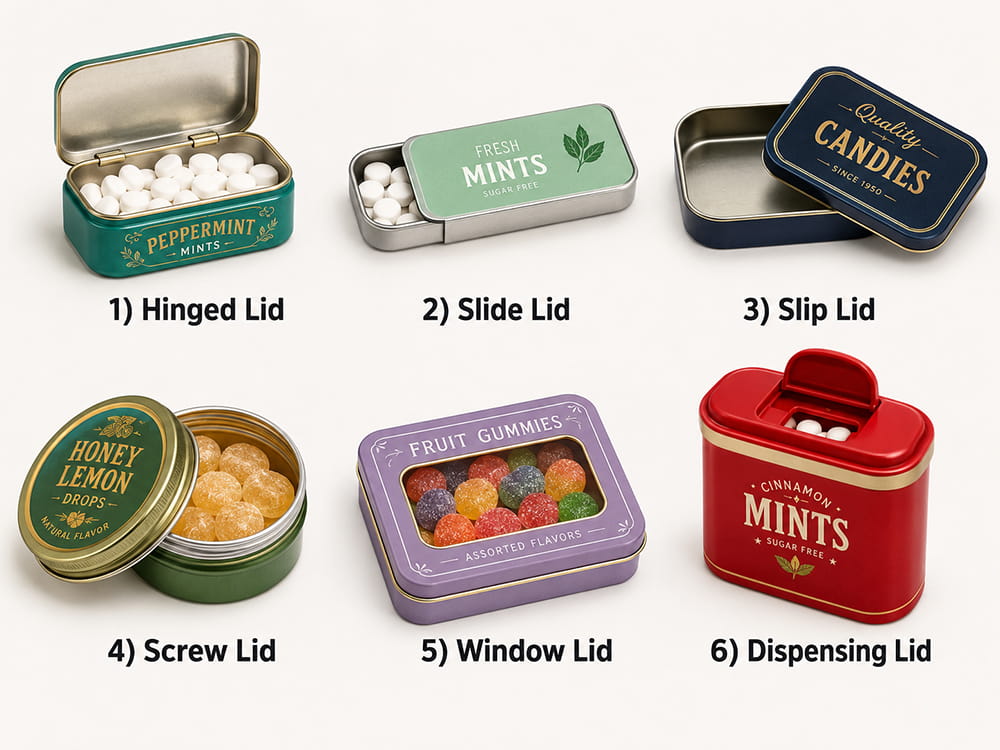
Some common candy tin lid structures are:
This type has a hinged lid that stays attached to the body, making it ideal for mints, gums, and small candies. And you can't lose the lid!
Slide tins are typically used for mints and small quantities of candies. They are small, easy to transport and are excellent for promotional items.
Slip lids are simple and cost-effective. They are suitable for many candy and gift tin formats.
Screw top tins give a more secure closure and might be suitable for premium candies, lozenges or small confectionery products.
A window lid allows consumers to see colorful candies inside. It can be a good fit for gummies, jellies and decorative sweets, but food safety and compatibility of materials should be verified.
Controlled dispensing can be a convenience for small candies or lozenges and can reduce product handling.
Before confirming a lid design, brands should test the opening force, lid fit, consumer usability, and sealing performance.
Candy is a highly visual product category. Colors, illustrations, patterns and finishes can have a significant impact on buying decisions.
Tin packaging gives candy brands a wide design canvas. Popular customization options include:
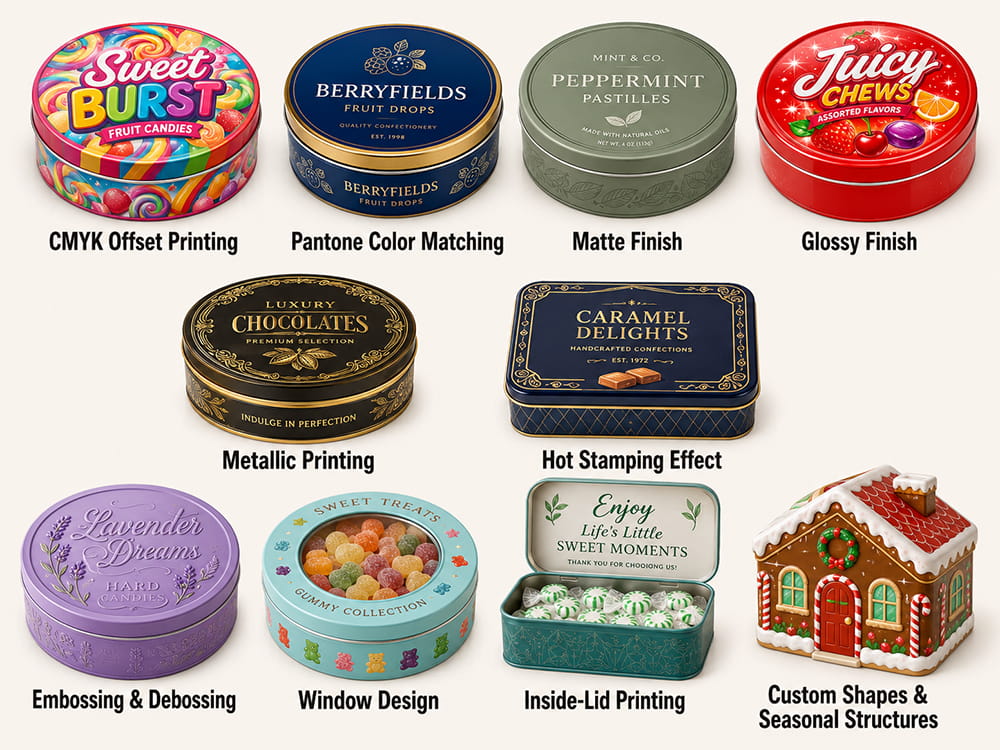
For candy brands, high-saturation colors often work well because they communicate sweetness, fun, energy, and flavor variety. However, premium chocolates or luxury candies may use darker tones, metallic effects, matte surfaces, or minimalist artwork.
Seasonal packaging is one of the strongest applications for candy tins. Brands can develop special designs for Valentine’s Day, Easter, Halloween, Christmas, weddings, corporate gifts, and limited-edition campaigns.
Special shapes such as heart tins, egg-shaped tins, star tins, Christmas tree tins, round tins, and small rectangular mint tins can help products stand out during seasonal promotions.
Candy brands often compare tin packaging to plastic bags, paper boxes and flexible wrappers. There are advantages to each, but for premium, gift and reusable products tin packaging offers some clear advantages.
| Packaging Type | Strengths | Limitations | Best Use |
|---|---|---|---|
| Tin packaging | Durable, reusable, recyclable, premium appearance, strong protection | Higher initial cost than simple flexible packaging | Premium candy, mints, chocolates, seasonal gifts, collectible packaging |
| Plastic packaging | Lightweight, low cost, flexible, easy for single-serve products | Lower perceived value, environmental concerns, limited reuse | Mass-market candy, single-serve packs, low-cost retail |
| Paper boxes | Printable, lightweight, familiar, relatively economical | Weaker moisture and crush protection unless combined with inner packaging | Retail cartons, boxed assortments, secondary packaging |
| Glass jars | Transparent, reusable, premium feel | Heavy, fragile, higher shipping risk | Boutique candy stores, local retail, display packaging |
For brands that want shelf impact, gift value, longer term reuse and stronger product protection, candy tins often offer a better balance than disposable plastic or simple paper formats.
When sourcing candy tins, unit price is important, but it should not be the only decision factor.
A very low price may become expensive if the supplier has poor printing control, weak lid fit, coating issues, delayed samples, rust problems, high defect rates, or poor export packing.
If you’re a well-known brand, a custom mold can be more differentiating, especially for long-term product lines, season gift collections and brand-only packaging.
Always test physical samples before mass production. Samples help check tin size, coating quality, lid fit, printing color, embossing effect, inner tray layout, product capacity and carton packing.
Good candy tin manufacturers should not only be producing but also helping buyers to evaluate packaging structure, food safety, printing feasibility, mold option, sampling, QC, and export packing.
Before choosing a supplier, ask yourself the following questions:
A professional manufacturer should be able to discuss not only price, but also structure, quality control, safety, timelines, and risk prevention.
Candy Tin Packaging is a Brand and Supply Chain Decision Candy tin packaging is not a design decision alone. It is a food safety, consumer experience, supply chain and brand positioning decision.
The best candy tin manufacturer is not always the cheapest one. It is the one that can help you with the right material, structure, coating, lid, printing process, MOQ, sample plan and export packing method for your product.
For candy brands, the smartest packaging choice starts with clear questions:
When these questions are answered clearly, custom candy tins become more than packaging. They are a valuable source for safeguarding confectionery, improving shelf appeal, increasing sustainability and creating long-term brand awareness.
Most candy tins are made of tinplate , which is steel with a thin coating of tin . Depending on whether the candy comes in direct contact with the tin , food-grade coatings or inner liners may be used .
Yes, candy tins can be safe for food packaging if they are made from food grade tinplate, with the correct inner linings, food safe inks and appropriate compliance documentation.
Candy tins are great for mints, hard candies, gummies, chocolates, truffles, lozenges, toffees, jellies, seasonal candy gifts and promotional confectionery products.
Yes. Candy tins can be customized in shape, size, color, printing, finish, embossing, debossing, window design, lid structure and inner tray.
Mints are sold in small hinged tins, slide tins, click-clack tins or compact round tins as they are portable and convenient.
Chocolate tins often need trays, liners, dividers or inner pouches to protect the surface quality and improve presentation.
Yes. Candy tins are often reused by consumers for storage or decoration and tinplate is recyclable.
Evaluate food grade experience, certifications, coating options, availability of mold, ability to customize, sample speed, MOQ, quality control and export packing experience.
Get The Latest Information And Special Offers


 IPv6 network supported
 English
 Français
 Deutsch
 Español
 Português