
Tea tins are not just a packaging design choice, and it is not just for tea brands and wholesale buyers. It is a sourcing decision that affects product freshness, carton efficiency, shelf presentation, MOQ, tooling investment, and the long-term value of the brand.
A tea tin that looks beautiful but does not fit the real tea volume, cannot hold tea bags neatly, dents easily during shipping, or has an unsuitable lid structure can create problems after production starts. This is especially important for wholesale tea tin orders, where small design mistakes may be repeated across thousands of units.
This guide focuses on practical decisions tea brands should confirm before ordering custom or wholesale tea tins, including tea format, capacity planning, lid structure, mold choice, printing system, shipping efficiency, and supplier evaluation.
Before asking a supplier for a quotation, it is helpful to define the packaging project clearly. Tea tins are not one-size-fits-all containers. The same tin may work well for one tea format but fail for another.
Wholesale buyers should first confirm:
Answering these questions early helps the tea tin manufacturer recommend the right size, structure, lid type, material, and printing solution.
Different tea formats require different packaging structures. You might not want to store fluffy herbal blends in a tea bag tin, and a typical loose leaf tea tin might not be enough to protect your matcha powder.
| Tea Format | Main Packaging Challenge | Practical Tea Tin Recommendation |
| Loose leaf tea | Tea volume varies greatly by leaf shape and density | Use wide-mouth tins, round or square tins, and consider inner plug lids |
| Tea bags | Need neat arrangement and easy daily access | Use rectangular or square tins with hinged or removable lids |
| Matcha powder | Sensitive to moisture, oxygen, and odor | Use compact tins with inner seal, screw lid, or sealed inner pouch |
| Herbal / fruit tea | Often bulky, lightweight, and aromatic | Use larger tins with enough headspace and optional inner pouch |
| Gift tea sets | Need premium presentation and multiple flavor organization | Use sets, dividers, stackable tins, or coordinated small tins |
For wholesale projects, testing with real tea samples is important. A supplier can estimate capacity, but only an actual filling test can confirm whether the tea sits properly inside the tin and whether there is too much or too little empty space.
One common mistake in tea tin sourcing is choosing the tin size by weight alone. Tea is different from biscuits, candy, or many other dry foods because its volume changes dramatically by type.
For example, 100g of rolled oolong may take much less space than 100g of white tea. Herbal blends with flowers, dried fruit, and large leaves may need a much larger tin than black tea of the same weight. Tea bags also need a different internal shape because they must sit neatly without being crushed.
Capacity planning should include:
For loose leaf tea, a wide opening improves the user experience because customers can easily use a spoon or scoop. For tea bags, a rectangular interior often allows better arrangement. For matcha powder, a smaller compact tin with stronger inner protection is usually more practical.
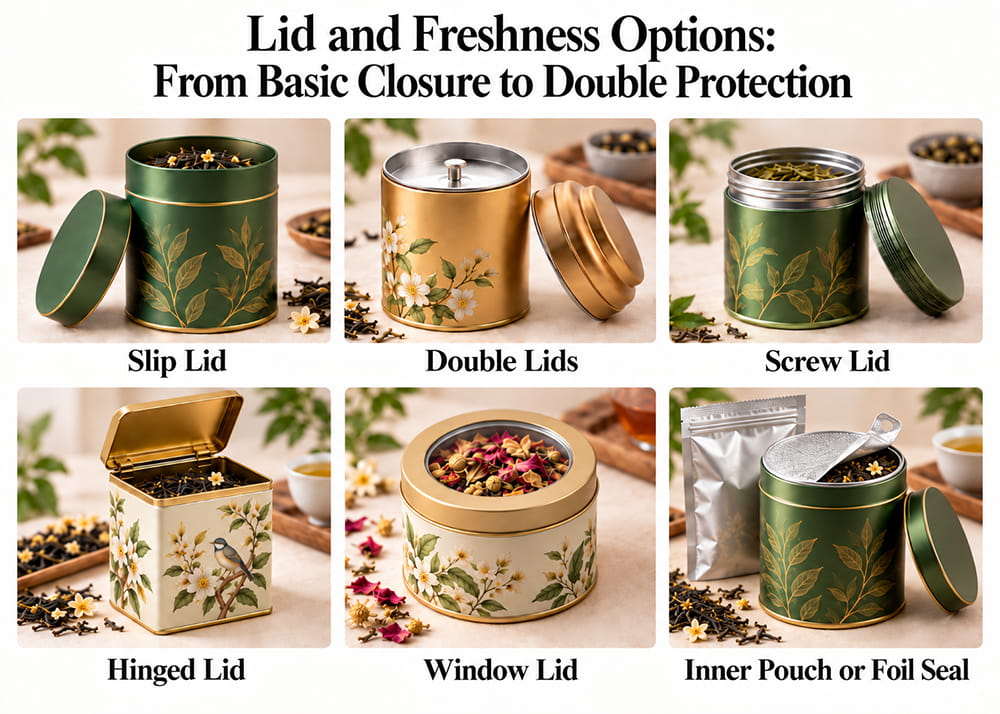
Many tea tin suppliers describe their products as airtight, but it is more professional to evaluate sealing performance by structure.
Most standard metal tea tins are not truly hermetic by themselves. But good lid design and internal packaging can make a huge difference to protecting aroma and minimizing exposure to light, air, moisture and odors.
Common tea tin lids are:
Slip lids are basic, cheap and are often used for retail tea tins. It is suitable for everyday loose leaf tea and standard tea packaging projects.
A double lid usually includes an inner plug lid and an outer decorative lid. This structure is popular for premium loose leaf tea as it gives a better opening experience and better aroma protection than a basic slip lid.
A screw lid provides a more secure closure experience and is perfect for small tea tins, matcha tins, travel tins and premium canisters.
A hinged lid keeps the lid on the body. This is useful for tea bags, sampler sets and gift tins where customers may be opening and closing the package often.
A window lid enables consumers to see colorful herbal or fruit tea blends. But brands should think carefully about whether the visibility of the product is worth the diminished light protection for light-sensitive teas.
For premium green tea, matcha, white tea or aroma-sensitive blends, the best structure is often a sealed inner pouch or foil bag inside the tin. This gives double protection for the product: the tin provides structure and branding, while the inner pouch improves freshness protection.
Brands must test lid fit, opening force, sealing feel, and repeated-use performance prior to mass production.
Choosing the mold is the key to controlling the cost and timeline of wholesale tea tin projects.
For new tea brands, seasonal products and market testing, it is generally more practical to use existing mold, which can reduce tooling investment, shorten sampling time and speed up the quotation process.
Custom mold development is more appropriate when the brand needs a unique structure, an exclusive shape, a long-term product line, a premium gift set or a strong shelf differentiation.
| Mold Option | Best For | Advantages | Considerations |
| Existing mold | Startups, test orders, seasonal launches, standard retail tins | Lower tooling cost, faster sampling, mature structure | Less exclusive appearance |
| Modified existing mold | Brands needing small adjustments | Balances cost and differentiation | Modification feasibility must be checked |
| New custom mold | Long-term brand lines, luxury tea gifts, exclusive shapes | Strong differentiation and brand ownership | Higher tooling cost and longer development time |
For new tea brands, it’s better to start with the standard round, square or rectangular tins to reduce the initial investment. After the product line is stabilized, the custom mold can be considered for the premium collection or signature packaging.
Most tea brands sell multiple SKU’s (like green tea, black tea, oolong, herbal tea, fruit tea and seasonal blends) and packaging in this case should be planned as a product line, not one container.
A good tea tin system might consist of:
This makes it easier for customers to recognize the brand and makes for a more organized look on the retail shelf.
For example, a brand could use green for green tea, navy for black tea, warm brown for oolong, and floral colours for herbal tea. Premium gift editions could add metallic elements, embossing or inside-lid printing while keeping the same basic brand identity.
Tea tins provide a large surface area for printing, making them ideal for storytelling, cultural design and premium branding. The best finish however, depends on the brand positioning and sales channel.
The most common customizations are:
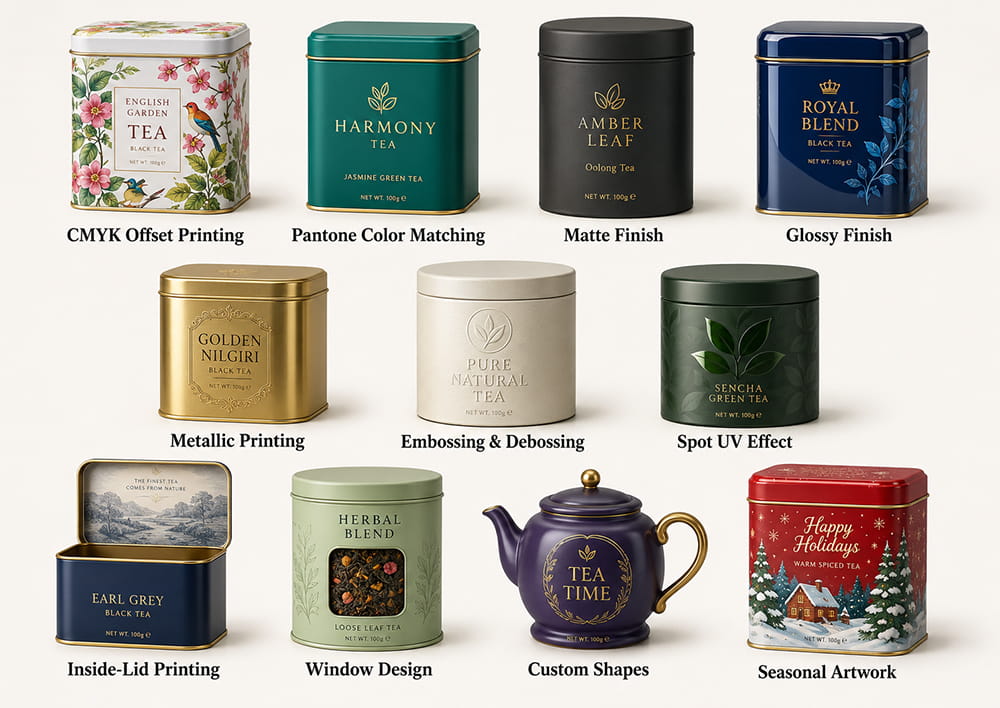
Different tea categories often need different visual languages.
Green tea packaging: natural colors, white space, botanical graphics. Black tea packaging: classic colors like red, navy, cream, gold. Oolong, pu-erh packaging: cultural patterns, calligraphy, textured finishes, oriental-style designs. Herbal teas packaging: floral illustrations, brighter colors, softer visual cues. Gift tea sets can incorporate metallic accents, embossing and collectible packaging structures.
For wholesale production, color consistency is very important. If one product line contains several tins, visible color difference between batches can weaken the brand image. Pantone matching and pre-production sample approval should be part of the process.
For tea tins wholesale orders, shipping efficiency can affect the total cost as much as the tin unit price.
Traditional round tins also tend to have more empty space in the carton. Square and rectangular tins generally provide better carton utilization, and stack more easily on retail shelves. Large gift tins may have a volumetric weight especially if there are several small tins or inserts in them.
Considerations for wholesale buyers:
If tins are being sent empty to a filling facility, nesting can reduce shipping volume. If the tins are filled with tea before shipping, the carton structure must protect the tin and the product inside.
Tea brands often compare metal tins to other packaging formats. All materials have a role but they are not equal in protection, presentation and reuse value.
| Packaging Type | Strengths | Limitations | Best Use |
| Metal tea tins | Strong protection, premium look, reusable, recyclable, blocks light | Higher initial cost than basic pouches or paper boxes | Premium loose tea, gift sets, retail tea lines |
| Paper tubes / boxes | Lightweight, printable, craft appearance | Weaker moisture and aroma protection unless lined | Eco-style branding, secondary packaging, short shelf cycles |
| Plastic pouches | Lightweight, economical, flexible | Lower premium feel, limited reuse, recycling concerns | Refills, mass-market products, inner bags |
| Glass jars | Product visibility, reusable, premium appearance | Heavy, fragile, allows light unless tinted | Boutique display, local retail, decorative storage |
For many tea brands, a practical solution is to use metal tins for premium retail and gift products, and pouches for refill packs. This allows the brand to balance cost, freshness, shelf presentation, and sustainability messaging.
Tea is a dry food product but material safety is still important. When ordering wholesale tea tins buyers should confirm whether the tea touches the tin directly, or is first packed in an inner pouch.
Key considerations include:
If the tea is in direct contact with the tin, the inner coating and food contact documentation should be verified before mass production. If the tea is packaged in a food safe inner pouch, the tin is primarily outer protection, branding, and reusability for storage.
Tea tins wholesale pricing depends on more than size.
Main cost factors include:
A low unit price may not be the best choice if the supplier has poor lid fit, unstable printing color, weak export cartons, delayed sampling, or limited food-safety support.
For B2B buyers, it is better to evaluate the total packaging cost, including sample cost, mold cost, defect risk, production lead time, shipping efficiency, and after-sales communication.
A reliable tea tin manufacturer should do more than provide a price. The supplier should assist in the assessment of structure, capacity, food safety, printing feasibility, mold choices, quality control and export packing.
Before ordering ask the supplier:
A good supplier should help you choose the right packaging solution based on the tea product, not simply recommend the most expensive or most decorative tin.
Wholesale tea tin packaging should be planned from product reality, not just visual design.
Before confirming a tin, brands should understand:
When these factors are considered together, tea tins become more than containers. They protect tea quality, improve shelf presentation, support gift value, reduce packaging mistakes, and create a reusable brand asset.
Most tea tins are made from tinplate, which is steel coated with a thin layer of tin. Some small seamless tea tins may use aluminum. The best material will depend on size, structure, cost and product requirements.
Yes. Tea tins are widely used for loose leaf tea because they block light, provide rigid protection, and support tight-fitting or double-lid structures that help protect aroma.
Most standard metal tea tins are not truly hermetic by themselves. However, tight-fitting lids, double lids, screw lids, liners and inner sealed pouches can improve the protection of freshness.
Matcha powder is sensitive to air, moisture and smell. It is often recommended to use compact tins with inner seals, screw lids, sealed inner pouches or foil protection.
Tea bags are most often packed in square or rectangular tins. This is for a neat arrangement and for efficient packing in shelves or cartons.
Existing molds can save cost and time on new brands but custom molds can allow more differentiation for established brands or premium gift lines.
Yes. Tea tins can be customized with CMYK printing, Pantone colors, matte or glossy finish, metallic effects, embossing, debossing, window lids, inner lids and custom shapes.
Have your tea type, target volume or weight, preferred shape, lid structure, artwork direction, order quantity, target market, food-contact requirements, and shipping destination in mind.
If you are planning a tea tin packaging project for loose leaf tea, tea bags, matcha, herbal tea, gift tea sets or seasonal collections, please start by confirming the tea format, actual product volume, lid structure, inner packaging, artwork direction, order quantity and destination market.
A professional manufacturer of tea tins can help to evaluate the mold options, material, coating, printing, sealing structure, samples and export packing before the mass production.
Get The Latest Information And Special Offers


 IPv6 network supported
 English
 Français
 Deutsch
 Español
 Português