
Buyer wants a round tin that will hold 454 grams Danish butter cookies. The shape is known, the target weight established, the artwork may already be in the works.
Not enough information to determine the packaging.
A variety of butter cookies could be rings, rectangular fingers, round cookies, swirls and pretzel shapes. And they each occupy space in a different way. Each may respond differently in the filling and export shipping. When paper cups, layer pads and a sealed inner bag are added, the available space changes again.
A traditional mixed assortment will commence with a shallow round tin with a solid lid, paper cups or a hybrid support system, a top pad and a properly specified sealed inner bag. It’s a starting point, not a standard recipe. The real cookies are the ones you've got to build around the final structure.
That’s the main idea of this guide:
A Danish butter cookie tin is not made for one cookie. It is about the full range.
The layout depends on the product size. The layout defines the internal packaging. Those decisions decide the size of the tin. Branding only makes sense after the physical pack.
Typically, a sample cookie is enough to model a batch of the same chocolate chip cookies. Less obvious is the Danish butter cookie collection.
A solid round cookie could withstand the motion that would snap the thin link of a pretzel shaped cookie. The rectangle finger can be taller in its paper cup than the swirl beside it. The vibration may cause sugar crystals and crumbs to collect around the outer row, and what was once a neat arrangement can look untidy.
There’s also a visual language that’s been built with the product. In many markets Danish butter cookies are connected with a round tin made of metal, rich in color, with a decorative lid and with cookies arranged in an orderly way in paper cups.
That familiarity is helpful. It helps customer to understand product fast.
It’s also a branding problem. But when several tins are similar in color, central emblems and traditional European imagery, an individual brand can get lost in the category.
So the packaging has to do a few things at the same time.
A successful tin balances all 7. Rarely is the best result achieved when the lid design is the focus and the internal layout is something to be decided later.
We ask the buyer to share information of the finished cookies prior to the review of the molds.
That usually covers:
The word “production” is key.
The development cookies are usually meticulously chosen. They could be more consistent than the product of a full commercial run. If you make a tray cavity or paper-cup setup around one ideal sample, larger cookies may be hard to load, and smaller pieces could have room to move.
This problem is most apparent when an artwork layout shows each cookie as the same yellow shape. Real cookies are messier. Normal variation is introduced during dough forming, baking and cooling.
The packaging has to accommodate that range, without requiring the packing team to pick cookies one by one.
The order we would like is:
Finished assortment → opening presentation → inner packaging → inner usable dimensions → outside tin size
We explain this process further in our guide on how to calculate how many cookies can fit in a tin.
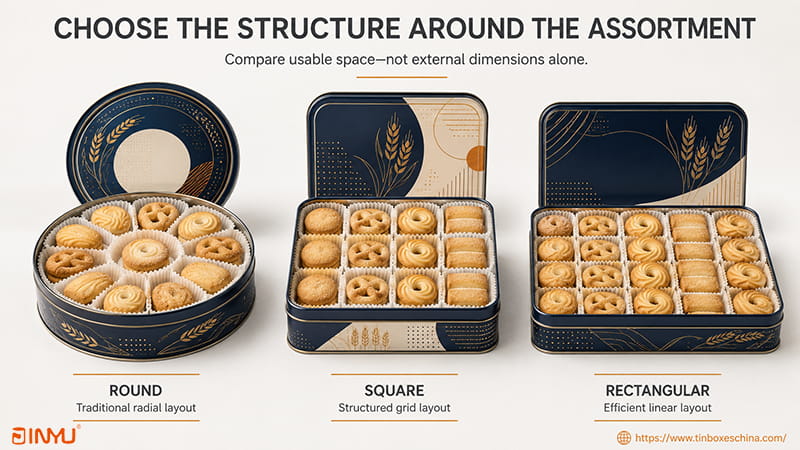
For many Danish butter cookie ranges the round tin is still the obvious first choice. Looks familiar, supports radial arrangement and has a traditional gift presentation.
But “traditional” is not the same as “mandatory”.
| Tin format | Best suited to | Main advantage | Main point to verify |
| Round tin | Classic mixed assortments and radial layouts | Strong category recognition and familiar gift appeal | Usable diameter, center space and master-carton arrangement |
| Square tin | Grid layouts, modern brands, retail-efficient formats | Stable presentation, larger uninterrupted artwork panels | Corner use, insert fit, overall category recognition |
| Rectangular tin | long cookies, flavor rows and linear layouts | good space utilization for fingers and grouped assortments | unused space around circular or irregular cookies |
On most traditional projects we would start with a shallow round tin and a solid lid. It usually is the most natural match for mixed shapes in paper cups.
When there's a clear reason, like we would go to a square or rectangular format:
The comparison of the logistics should be based on real numbers.
A round tin can leaves unused space within a rectangular export carton, but there is no meaningful universal percentage applicable to every project. Result is affected by tin diameter, carton dimensions, gross-weight limits, dividers and pallet configuration.
Request the supplier to make a comparison of:
It gives a useful commercial comparison. It is not enough to say that one shape is “more efficient”.
There are many different ways to arrange mixed butter cookies.
A radial layout is when the cookies are arranged around the center of a round tin. It creates the traditional presentation many consumers expect to see. The challenge is to utilize the center well. If there is too much white space, the assortment may look underfilled.
A ring-and-center layout has one or more shapes around the perimeter and a different cookie in the center. This can provide an attractive opening view if the quantities work both visually and physically.
Grouped layout means that each shape or flavor gets a defined area. This is easier for the consumer to understand and may simplify counting, but it can require several paper cup sizes or a more structured insert.
Any of these arrangements can look perfect in a drawing.
The packing bench is more fussy.
Paper cups spread out when opened. Irregular cookies, touch in odd places. A taller middle cookie may be pushing on the upper pad. The inner bag can fold into the outer row and alter the apparent diameter of the pack.
Therefore we do not believe that a layout is approved because the cookies fit in an open tin.
The complete pack to build:
The question is not just if it all fits on the first day. The question is whether the arrangement still looks presentable after filling, case packing, distribution and retail handling.
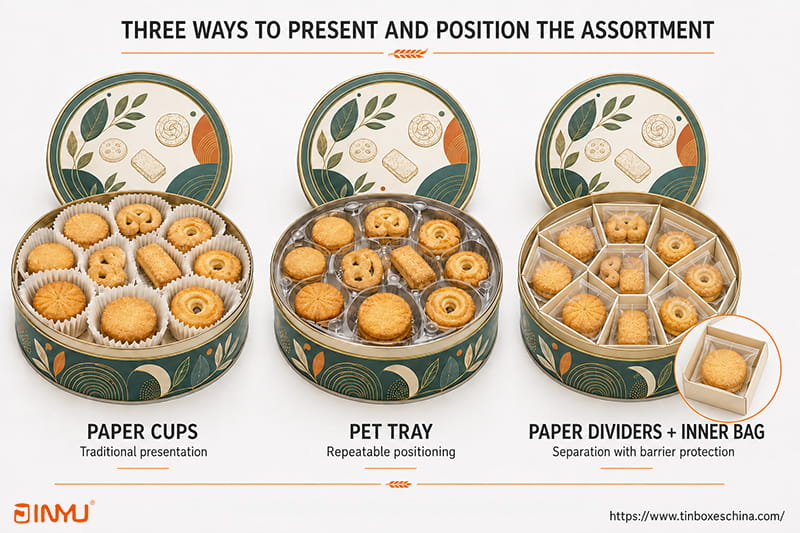
It has long been associated with paper cups: the classic Danish butter cookie experience. They add height to the arrangement, break up elements of the assortment and make it easier to pick up individual cookies.
A formed tray takes a different approach to the problem. The cavities hold the cookies in more repeatable positions, and make the intended layout easier to reproduce.
The hybrid system offers support and maintains the familiar paper format.
| Internal format | Strengths | Limitations | Good for |
| Paper cups | Traditional presentation, easy lifting and localized crumb control | Limited vertical control, more manual handling | Classic gift assortments where opening appearance matters |
| Formed PET tray | Repeatable positioning and controlled cavity dimensions | Reduces some usable space and may look more industrial | Fragile shapes and projects requiring consistent placement |
|
Paper divider + Inner bags |
Provides duplicate protection | Includes extra parts and assembly steps | Premium assortments that require visual harmony and improved motion control |
The most commonly missed dimension on paper cups is the opening width.
Cups can be ordered by base diameter, but the fluted sides open up when the cookie is inserted. It is the open profile, not the flat cup that comes in a sleeve, that has to fit into the arrangement.
Paper cups add to the work of filling them, too. They have to be separated, opened, positioned and checked before or whilst being loaded. Rather than using a generic labor percentage we suggest to time both proposed formats under the real packing conditions at the buyer’s premises.
In a simple trial the same number of packs, operators and cookies can be used to show:
PET trays may help speed placement, and make placement more repeatable, but they have their own engineering checks to do. Cavity length, width, depth, bottom radius, flange thickness and finger clearance all reduce the nominal space available for the cookie.
Sometimes the answer is not paper or plastic alone. A paper cup can be combined with a discreet supporting insert or top pad, which allows the consumer to maintain the traditional presentation without having to ask the cup to control every direction of movement.
Our detailed comparison between paper cups, formed trays, dividers and inner bags explains the different roles in more detail.
A single layer arrangement is usually the strongest opening presentation. You see every shape, you can see into the pack better and no lower layer is hidden under the weight of the cookies above.
The trade-off is in size. You may need a larger tin to reach the weight you are aiming for.
More layers mean more capacity with less increase in diameter, but the answer is more than just choosing a deeper tin.
The development team is yet to decide on:
Two layers are not automatically safe, and three layers are not automatically unsuited. The result depends on product strength, layer arrangement, pads, headspace and distribution conditions.
We're looking for enough clearance to avoid unwanted pressure, but not so much that the cookies are constantly lifting and dropping while traveling. There is no universal top clearance number for all shapes.
The thick round cookie and the thin pretzel-shaped cookie are not to be considered as having the same tolerance.
The assortment is sorted by paper cups, trays and dividers. The environmental exposure is controlled by the film structure and the sealing performance of the sealed inner bag.
The one cannot automatically take over the other.
A tray may prevent two cookies rubbing together but not one providing a barrier of moisture or oxygen. A high barrier bag can sustain the required shelf life, but with the entire range moving inside an over sized tin.
If you want butter-rich cookies, specify the bag with the food producer or packaging-film supplier. Discussion should address:
Don’t choose a film on one OTR or WVTR number. The value of this to the actual pack is influenced by the units, test conditions, total film area and the finished seal.
Once the bag is filled, it should also be weighed.
An empty flat bag. You do not fill and seal a bag. Side gussets, trapped headspace and folded heat seal areas can push against the paper cups or add to the height of the complete pack.
The appearance of the arrangement can be maintained with a transparent film, but reflections and folds have to be checked. But an opaque foil structure can also mean a very different level of protection, and again, it changes the opening experience.
Where the consumer can only see an opaque bag it is unlikely to be worth adding a window to the lid. If the bag is clear, and it is a tidy assortment, a window still can work.
The selected lid should not be described as airtight just because it is metal. The sealed inner bag is the main freshness barrier for many butter cookie projects. We explore this difference in our guide to window and solid cookie tin lids.
The first experience is not something you can judge from a dieline.
The consumer lifts the lid, sees the first layer and decides if the product feels generous, careful and gift-worthy. The appeal is the variety of shapes and the mixed butter cookie assortment.
Paper cups also give the illusion of more cookies because the pieces are vertical and take up more visual space. Using a flat tray can make the arrangement look cleaner and more controlled, but it can also make it feel quiet.
Neither reaction is better than the other. Depends on the brand.
The point is, the effect is intentional.
When you examine a complete sample, ask:
Inside lid printing can help with this moment. It may tell a short brand story, identify the different cookie shapes, or provide serving information.
We also have a simple test that we find useful. Give the complete sample to someone who has not worked on the project and see how they open it. Their first move is usually an awkward bag fold, a loose pad, or an unclear presentation that the development team has stopped noticing.
In many markets, butter cookies have familiar colors of blue, cream and gold. Shoppers instantly recognize the category by the round tin, the central emblem and the traditional illustration.
The problem is not the blue itself. The problem is using the same blue, the same border, the same imagery as everybody else.
Blue can put a product into the category. It cannot do all the work of the brand building.
A special system may employ:
The brand can also shift away from blue. But, with the structure, typography and imagery in place to do the job, colors such as cream, warm gray, deep green and berry red can still convey a premium butter cookie product.
Ask two questions:
What known signals do the customer use to understand the product?
What are the definite elements of our brand?
Those questions are more useful than asking if the tin “has to be blue”.
A mature product category doesn’t need more decoration just because the package is metal. Choose a single main focus – a central emblem, illustration, color contrast or embossed element – and make the rest complement it.
We introduce CMYK, Pantone colors, metallic effects and embossing to explain how these treatments perform on formed tinplate.
The strongest retail message is on the lid. It needs to work on a shelf, in an online product image and in a gift display.
The sidewall is used when tins are stacked or displayed below eye level. A color, border or pattern extending around the body helps to ensure the product is identifiable when the full lid cannot be seen.
The base is usually reserved for practical information such as ingredients, allergens, net quantity, storage instructions, barcode, batch details and importer information, depending on the destination market.
That information, plan it before the artwork gets crowded.
Small text can be hard to read if it is too close to a formed edge. A barcode that spans a curved area or seam may also be harder to scan.
Print inside the lid if desired. When it’s used it should bring something that the outer lid can’t, like an assortment guide, a brief brand story, serving information or a simple reuse idea.
A blue round tin or a Nordic-style illustration doesn’t tell you where the cookies were created.
Before printing, the product owner should verify that the terms “Danish”, “Made in Denmark”, “Danish recipe” or “Danish-style” are true descriptions of the product and acceptable in the destination market. These expressions are not to be used interchangeably.
The same care is needed for:
This is a decision that the tin manufacturer cannot make for himself. The product owner needs to show the whole artwork to its legal or regulatory adviser for a review.
The general design should also be original. A common category color can be widely used but the combination of similar colors, typography, imagery, emblems and layout can make a new product look too similar to an established competitor.
Originality is not just a legal protection. This aids the consumer in remembering the product.
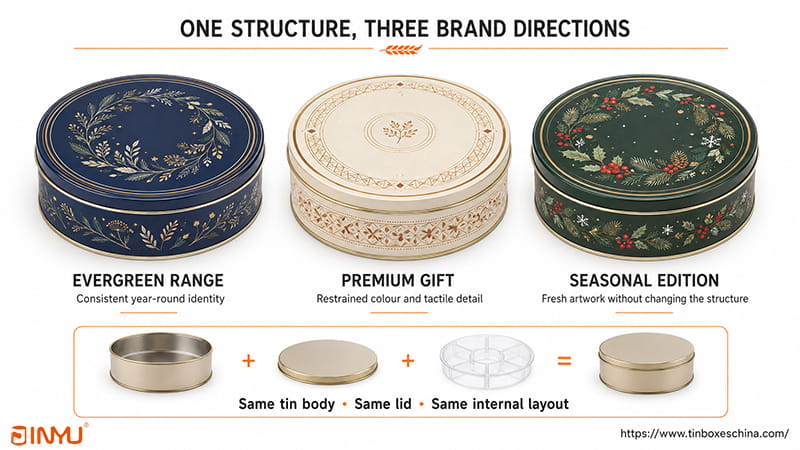
A box of Danish butter cookies could be a year-round seller with a big gifting spike during major holidays.
Every seasonal edition doesn’t require a rebuild of the entire packaging system.
A well-designed range can share:
The decoration can then give the seasonal identity.
This is the biggest visual change and works well when the seasonal volume justifies a separate printed run.
This provides additional inventory flexibility. If the seasonal component is removable, unsold base tins may still be usable after the holiday.
This leads to a visible seasonal difference, while keeping more of the physical structure the same.
No matter which path you choose, try to keep the selection of cookies consistent. Changing the print is doable. Changing the print, cookie count, paper cups, bag and carton all at once creates a new packaging project.
Do not add a year to permanent metal artwork unless it is part of a deliberate strategy to create annual collectability. An old tin is a whole lot harder to sell after the intended season.
Also the seasonal development should be planned backward from the retail date. Artwork, sampling, insert confirmation, production and export shipping all take time. To see how these stages work together, check out our Christmas packaging timeline.
The butter cookie tin as a sewing box is a familiar household joke for a reason: people often keep a useful and attractive metal container.
That second life makes the product more attractive.
A reusable tin does not need a sustainability claim over the top. It has to be practical and visually relevant after the OG cookies disappear.
Ask yourself:
A heavily dated promotion can work for a short campaign. A restrained design is more likely to stay in a kitchen, office or sewing cupboard.
That means ongoing visibility for the brand long after the food packaging has done its first job.
The main cost variables are whether an existing or new mold is used, the size of the tin, the number of designs printed, the paper-cup assembly, the tray tooling, the inner-bag specification, color requirements, embossing, surface finish, carton configuration and freight.
Paper cups have a low component price, but more handling. PET trays may still need tooling but they do make positioning more repeatable. The proper comparison is the total packed cost, not the price of one insert.
If the budget is tight, focus on the essentials first:
Next are the decorative upgrades. A single embossed logo in the right place is often better than several disconnected special finishes.
For a more detailed explanation see our custom cookie tin quotation guide.
The order of the decisions may avoid multiple samples and changes of artwork.
The tin, insert, bag and carton are not to be approved as unrelated components. The retail package is only assembled.
The final specimen is not a handsome empty tin.
For a useful structure recommendation and quotation, please provide:
If the layout has not been developed yet, state so. It is preferable to consider the assortment before choosing a tin diameter, rather than to force the product into a catalog size selected too early.
The most expensive problems often start as small specification gaps:
These issues are inconvenient to discover during a pack-out test. It is expensive to trace tins after thousands of them have been printed.
For a standard mixed selection we usually begin with a shallow round tin as it works well for radial arrangements and gives a recognizable presentation as a gift. Square and rectangular tins might be more suited to modern branding, linear layouts or specific logistics requirements.
Begin with the biggest allowable production cookies and where they are to be. Add the opened sizes of paper cups, tray walls, bag folds and tin structural allowances. Calculate from usable internal dimensions, not external catalog size.
They divide the bits of the assortment, gather up a few crumbs, render the raising of the cookies possible and arrange the upright showing of the classic butter cookie tin. They do not form a complete barrier and do not themselves control vertical movement.
Sometimes. This has to be confirmed by real samples. A cup that fits a round cookie may be too loose for or too low for a narrow pretzel shape.
PET trays are generally more repeatable in their positioning. The paper cups make for a more traditional presentation. Nor is one universally better; a hybrid solution might combine both benefits.
It is contingent upon the formulation, target shelf life and distribution conditions. “Don’t automatically assume the tin lid is a hermetic seal. The barrier system to be used should be confirmed by the food producer and film supplier.
Usually one layer has a more powerful opening presentation and easier product control. Two-layer addition increases capacity but requires proper layer separation, headspace control, and transport testing.
No Blue is a well known category signal not a must. Brands can have their own blue or other color system. So long as the overall packaging clearly communicates the product.
Yes, sir. It’s a good way to develop evergreen and seasonal ranges by changing the printed artwork but keeping the same body, insert, bag and carton. All printed designs still need to meet the agreed MOQ.
First, compare the assortment to existing dies. A suitable existing structure can reduce tooling expense and development time. New tooling is justified when the desired layout, capacity or proprietary shape are not available with an existing option.
There’s no one shade of blue or one standard diameter for a successful Danish butter cookie tin.
It works because three decisions reinforce each other:
Begin with the cookies. Make the arrangement. Test the whole pack. Then use the metal surface to tell the story of the brand.
Jinyu has over 3000 existing tin molds for round, square, rectangular and special formats. We require a minimum order of 5,000 custom-printed cookie tins for each size and design. Sampling usually takes 7-10 days. Mass production takes around 25-35 days after final sample and artwork approved.
If you are producing a Danish butter cookie range, please send us the cookie shapes, production size range, quantity per variety, target net weight and intended market. The range can be checked against suitable existing molds and a workable layout worked out before the artwork is finished.
Get The Latest Information And Special Offers


 IPv6 network supported
 English
 Français
 Deutsch
 Español
 Português