
Many buyers think they are comparing tea tin suppliers when they compare unit price. In reality, they are usually comparing only the first visible number in a much larger cost structure. The supplier with the lowest quoted tin price is not always the one that produces the healthiest landed cost once shipping, packaging, duties, damage risk, and MOQ effects are added in.
This article explains how to calculate landed cost for wholesale tea tins more realistically, and just as importantly, how to redesign the project so the landed cost itself becomes healthier. That means looking not only at price, but also at structure choice, stock-tin strategy, sheet yield, sample validation, shipping mode, and inventory rhythm.
Tea tin sourcing becomes expensive when buyers treat cost as a factory quote instead of a supply-chain outcome. A tin that looks cheaper at the factory gate may create a higher final cost if it ships inefficiently, dents too easily, requires excessive inner packing, or forces a MOQ that ties up cash in slow-moving inventory.
The correct question is not “What is the unit price?” but “What does each usable, sellable tin cost when it arrives ready for sale?”
| Cost layer | What it usually includes | What buyers often miss |
| Product cost | Tin body, lid, material thickness, printing, finishing, accessories | Shape complexity, tooling implications, and MOQ-related setup effects |
| Packaging cost | Polybags, tissue, inserts, dividers, master cartons | How inner packing affects freight volume and damage rate |
| Freight | Sea or air transport, LCL/FCL, destination handling | Tea tins are often charged more by volume than by weight |
| Duties and taxes | Import duty, VAT/GST, customs brokerage | These often sit outside the factory quotation and distort comparisons |
| Damage and replacement | Dents, scratches, sealing failures, rejected pieces | A lower material spec can become more expensive after complaints and reorders |
| Inventory cost | Cash tied up in stock, warehousing, slow turnover | MOQ and launch timing can quietly damage margin even when unit cost looks good |
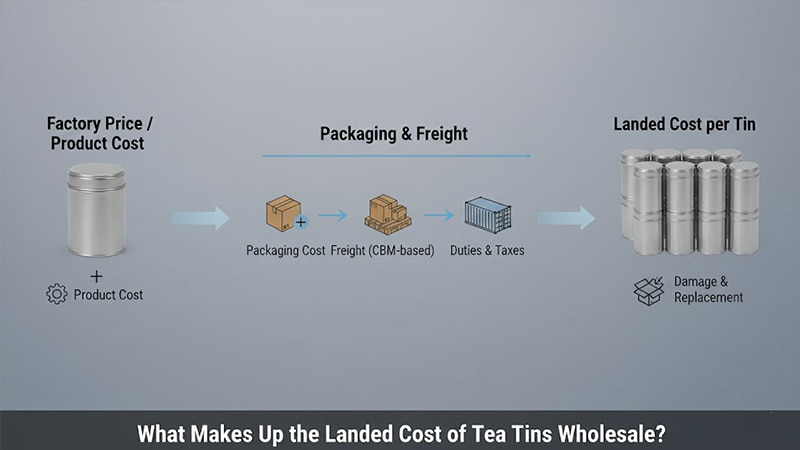
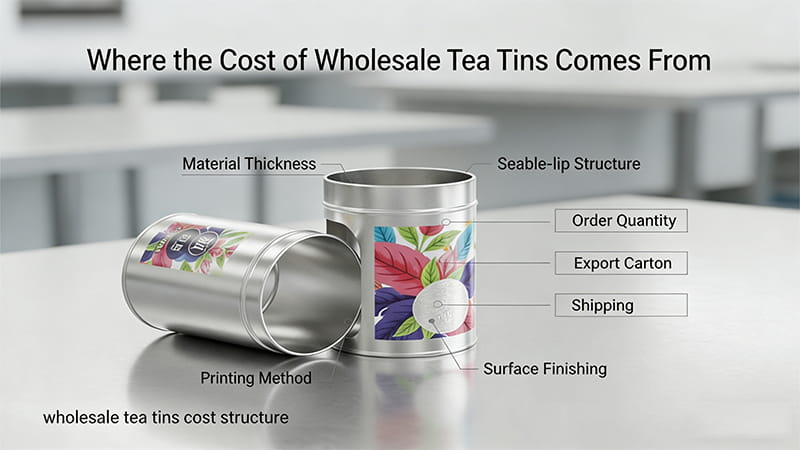
Product cost begins with the tin itself, but the meaningful differences usually come from structure and specification choices. Standard molds, simpler shapes, and selective finishing often reduce cost far more effectively than supplier negotiation alone.
| Choice | Lower-cost route | Higher-cost route | Why it matters |
| Mold path | Existing mold or stock tin | New custom mold | New tooling raises risk, lead time, and up-front capital need |
| Structure | Simple square, round, or standard rectangular format | Stepped lids, reinforced corners, special edges, unusual profiles | Structural complexity changes forming, tooling, and assembly cost |
| Decoration | Basic print or focused highlight | Full-surface premium finishing | Selective premium treatment often achieves a similar shelf result with better cost control |
| Material spec | Fit-for-purpose thickness | Over-specified thickness without a real export need | Too-thick metal can raise cost without improving sellable performance |
Real cost control often begins in design and specification decisions, not at the negotiation table.
One of the most expensive sourcing mistakes is approving a tin before the actual fit is properly tested. Wrong dimensions do not only increase shipping cost. They can also cause filling inefficiency, weak presentation, sealing issues, and wasted space inside the pack.
| Validation step | Why it should happen early | What it can prevent later |
| Volume test with real tea sample | Tea density varies by leaf style and cut | Oversized or undersized tins, bad fill appearance, weak retail usability |
| Fit and sealing check | Some tins look correct on paper but perform badly once filled | Poor closure performance, aroma loss, or customer complaints |
| Transit simulation with actual inner packing | Damage risk depends on the full packing system | Denting, movement damage, and replacement cost |
| Carton-level test | Freight efficiency and stacking depend on outer packing as well | Paying to ship wasted air or weak cartons |
Many landed-cost problems can be reduced before mass production if sample validation is treated as a cost-control step instead of a formality.
Inner bags, paper pads, inserts, and dividers are not only “extra packaging.” They influence freight efficiency, protection, and carton stability. A tin that needs more internal support may cost less as a unit but more as a delivered pack.
| Packaging choice | Main benefit | Possible cost trade-off |
| Simple bag or wrap | Lower packaging cost | May give weaker protection or presentation |
| Insert or divider | Better product stability and premium appearance | Raises packaging cost and can reduce carton efficiency |
| Heavier master carton | Improves shipping protection | May increase freight and packing cost |
| Optimized nesting/carton layout | Reduces shipped air | Requires better planning up front |
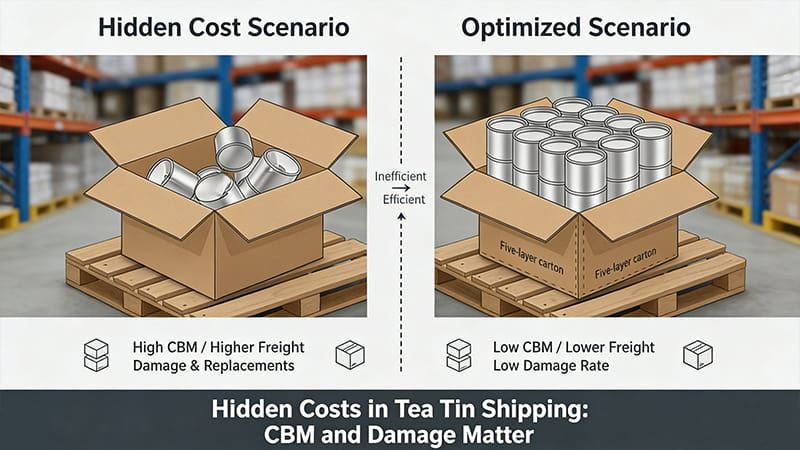
For custom tea tins, especially decorative or premium ones, freight is often driven more by cubic volume than by weight. Buyers who focus only on piece price and weight can miss the fact that a poorly optimized tin size or carton plan is effectively a decision to ship empty space.
This is why CBM efficiency matters. Standard shapes, smarter nesting, and carton planning often have a stronger effect on delivered cost than small differences in raw material price.
Not every tea tin project needs a fully custom structure. In many cases, landed cost improves significantly when buyers start from a stock tin or existing mold and invest only in the customization layers that customers actually notice.
| Budget-smart route | What it changes | Why it can outperform full custom |
| Existing mold + embossing | Adds a more custom feel without new full-structure tooling | Creates stronger perceived value with lower mold risk |
| Stock tin + private label system | Makes regulatory copy, origin, and ingredient updates easier | Useful for multi-market or frequently changing SKUs |
| Stock tin + interior upgrade | Uses liners, satin details, inserts, or frames to lift presentation | Improves perceived luxury without changing outer production flow |
| Stock tin + seasonal graphics | Supports low-risk testing for limited editions | Works well for launch validation and short lead-time projects |
For testing SKUs, holiday collections, or brands that are still validating demand, stock tins with smart customization often produce a healthier cost structure than full custom molds.
Some cost drivers are invisible to buyers because they sit inside factory production logic. Sheet layout efficiency is one of them. How artwork is positioned on tinplate sheets affects material yield and scrap. That means design decisions can influence cost even before freight is considered.
Another often-missed detail is defect visibility. Large solid color areas, especially on premium tins, can make small scratches or shipping marks more obvious. In some cases, a design that looks “cleaner” in concept produces a higher rejection rate in practice.
| Design choice | Factory-side effect | Commercial effect |
| Efficient sheet layout | Better yield and lower scrap | Lower real cost per usable tin |
| Poor artwork fit on sheet | More waste and lower material efficiency | Higher effective product cost |
| Large solid color surfaces | Minor scratches become more visible | Higher apparent defect risk after shipping |
| Selective premium decoration | Less process load than full-surface finishing | Better balance between visual impact and cost |
Sea freight versus air freight is only one part of the logistics decision. In many tea tin projects, the real question is how shipment timing aligns with sales rhythm. Temporary storage, staged releases, or partial shipments can sometimes improve cash flow and reduce inventory risk even if they do not produce the lowest theoretical freight number.
| Logistics strategy | Where it helps | Main trade-off |
| Full bulk shipment | Highest volume efficiency | More cash tied up in stock |
| Partial shipment | Aligns inventory with sales cycle | May raise per-shipment logistics overhead |
| Temporary storage strategy | Improves distribution flexibility | Adds warehousing cost |
| Sea-freight-oriented carton design | Better for export durability and stacking | May differ from air-oriented packing priorities |
| Trap | Why it happens | How better buyers avoid it |
| Comparing only ex-factory unit price | It is the easiest number to compare | Calculate cost per usable delivered unit instead |
| Ignoring MOQ effects | MOQ is treated like a supplier rule instead of a cost variable | Model cash flow, setup dilution, and stock risk together |
| Skipping sample validation | Buyers want to accelerate launch timing | Test fit, fill, sealing, and cartons before full production |
| Over-customizing too early | Brands equate premium with fully custom tooling | Use stock tins + partial customization for low-risk validation |
| Ignoring design-driven defect risk | Visual decisions are separated from production logic | Discuss yield and scratch visibility before finalizing artwork |
| Underestimating damage and replacement cost | Complaints are treated as exceptions instead of predictable cost | Choose material spec and outer packing based on route and market |
A strong tea tin sourcing decision combines pricing, packaging, freight logic, validation, and launch strategy. The cheapest quote can still become the most expensive path if it increases damage, weakens freight efficiency, forces an oversized MOQ, or locks the buyer into the wrong structure too early.
The most effective buyers usually do two things well. First, they calculate landed cost honestly. Second, they redesign the project so the cost structure becomes healthier before the order is placed.
The most useful tea tin supplier is not only one who can send a fast price list, but one who can explain how mold choice, sheet yield, sample testing, carton layout, shipping mode, and partial customization will change the final cost of the project. That is where real landed-cost control begins.

Get The Latest Information And Special Offers


 IPv6 network supported
 English
 Français
 Deutsch
 Español
 Português